Home>News >

The Inherent Safety of LiFePO4: Why It Stops Thermal Runaway Before It Starts

May 15, 2026 |BAKTH

1778826379986790.png

Table of Contents

  1. What Is Thermal Runaway & Why It’s Dangerous
  2. LiFePO4’s Olivine Structure: The Root of Safety
  3. Four Stages of Thermal Runaway: LiFePO4 vs NMC
  4. Lab-Proven Data: Safety Metrics Comparison
  5. The Seven Safety Layers of LiFePO4 Systems
  6. Real-World Applications Where Safety Is Non-Negotiable
  7. FAQ: LiFePO4 Thermal Runaway Safety
  8. Final Thoughts: Safety as a Core Feature

1. What Is Thermal Runaway & Why It’s Dangerous

Thermal runaway is an uncontrolled chain reaction in lithium batteries where rising temperatures trigger exothermic chemical reactions, generating more heat in a vicious cycle. If unchecked, it leads to catastrophic failure: violent fires, explosions, and toxic gas release.

Common Triggers of Thermal Runaway

  • Mechanical abuse: Punctures, crushing, or drops causing internal short circuits.
  • Electrical abuse: Overcharging, external shorts, or faulty chargers.
  • Thermal abuse: High ambient temperatures or poor ventilation.
  • Manufacturing defects: Micro-contaminants or misaligned layers leading to hidden shorts.

For decades, this risk has haunted lithium-ion technology—but not all chemistries are equal. LiFePO4 (LFP) stands alone as the only mainstream lithium chemistry with inherent thermal runaway resistance.


2. LiFePO4’s Olivine Structure: The Root of Safety

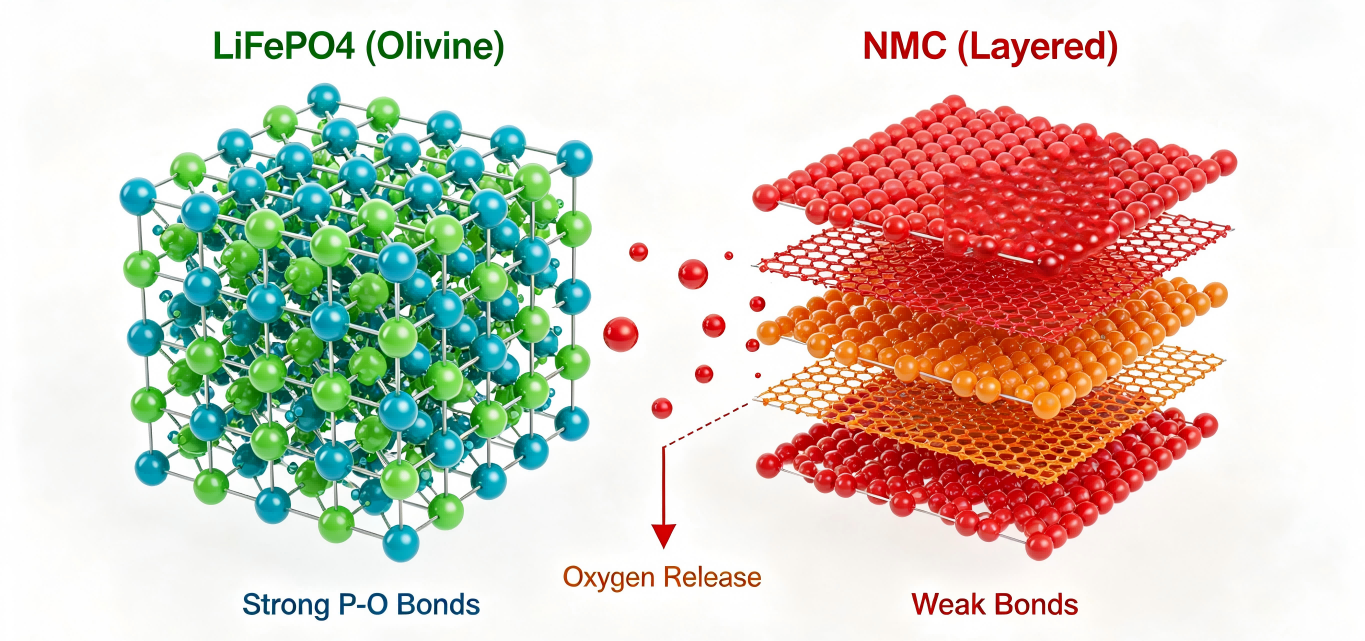
The safety advantage starts at the atomic level: LiFePO4 uses an olivine crystal structure with rigid 3D frameworks of iron (Fe) octahedra and phosphate (PO4) tetrahedra linked by ultra-strong covalent P-O bonds.

Key Structural Differences

  • NMC/NCA (Layered Structure): Weak metal-oxygen bonds break easily at 150–200°C, releasing oxygen that fuels combustion.
  • LiFePO4 (Olivine Structure): P-O bonds remain intact up to 400–500°C, locking oxygen tightly in the lattice—no oxygen, no fire.

Mechanical Stability

LiFePO4 expands <7%during charge/discharge (vs. 20–30% for NMC), preventing micro-cracks and internal shorts over thousands of cycles.


3. Four Stages of Thermal Runaway: LiFePO4 vs NMC

Thermal runaway unfolds in four predictable stages. The critical difference: LiFePO4 stalls the process at Stage 2, while NMC accelerates to catastrophic failure.

StageTemperatureNMC ReactionLiFePO4 Reaction
1~80°CSEI layer breaks down, heat beginsSEI remains stable, no significant heat
2~100°CElectrolyte decomposes, flammable gas buildsElectrolyte remains stable, minimal gas
3~130°CSeparator melts, internal short, rapid heat spikeSeparator may melt, but no oxygen release
4~150°C+Cathode decomposes, oxygen released → violent fire/explosionCathode remains intact, no oxygen release → slow overheating only

Critical Fact: LiFePO4 eliminates the oxygen fuel source that turns overheating into disaster.


4. Lab-Proven Data: Safety Metrics Comparison

Accelerating Rate Calorimetry (ARC) tests and industry studies confirm LiFePO4’s unmatched safety profile.

Thermal Stability Metrics

MetricLiFePO4NMC811Difference
Thermal runaway onset temperature350–400°C180–210°C~2x higher
Max heating rate0.18°C/min4,887°C/min27,000x slower
Peak temperature (abuse)~250°C~600°C50% lower
Oxygen releaseNoneSevereComplete elimination
Fire/explosion riskExtremely lowHigh83% fewer incidents

Real-World Test: Puncture Experiment

  • NMC: Ignites instantly, reaches 400°C in 10 seconds, violent flame projection.
  • LiFePO4: Slight heating, minor gas venting, no flame, no explosion, peaks at 300°C in 2 minutes.

5. The Seven Safety Layers of LiFePO4 Systems

LiFePO4’s inherent stability is enhanced by seven engineering safeguards, creating a defense-in-depth system.

  1. Material Inherence: Olivine structure locks oxygen, P-O bonds resist breakdown.
  2. Flame-Retardant Electrolytes: Additives raise flash points, reducing flammability.
  3. Smart BMS Monitoring: Real-time voltage/temperature tracking predicts and prevents anomalies.
  4. Thermal Management: Liquid/air cooling and phase-change materials control heat spread.
  5. Mechanical Armor: Aerospace-grade aluminum housings and ceramic-coated separators resist punctures.
  6. Thermal Barriers: Aerogel insulation (1/3 the conductivity of air) slows heat propagation.
  7. Emergency Venting: Directed pressure relief valves release gas safely, preventing cascading failures.

6. Real-World Applications Where Safety Is Non-Negotiable

LiFePO4’s safety profile makes it the first choice for applications where fire risk is unacceptable.

Best Use Cases

  • Home Solar Storage: Safe indoor installation, no fire/explosion risk.
  • RV & Marine Power: Vibration-resistant, no explosion in enclosed spaces.
  • Medical & Data Center UPS: Critical backup with zero fire hazard.
  • Commercial EVs: Buses, forklifts, and delivery vans prioritizing safety and longevity.
  • Off-Grid Systems: Cabins, remote towers, and industrial sites with minimal maintenance.

Less Ideal For

  • Long-Range Consumer EVs: Lower energy density (100–150 Wh/kg) vs. NMC (200–250 Wh/kg).
  • Compact Electronics: Size/weight priorities override safety advantages.

7. FAQ: LiFePO4 Thermal Runaway Safety

Q1: Can LiFePO4 batteries catch fire?
A: Extremely rare. Even under severe abuse (puncture, overcharge), LiFePO4 only vents gas or swells—no violent fire, no explosion.

Q2: What happens if I puncture a LiFePO4 cell?
A: Minor heating and non-flammable gas venting—no flame, no blast. NMC cells ignite instantly in the same test.

Q3: Does LiFePO4 still need a BMS?
A: Yes. While LiFePO4 is inherently safe, a BMS prevents overcharge/over-discharge and balances cells for optimal performance and longevity.

Q4: Is LiFePO4 safe for indoor use?
A: Absolutely. No toxic gas emission, no oxygen release, and no explosion risk—ideal for homes, offices, and medical facilities.

Q5: How long does it take for LiFePO4 to fail under extreme heat?
A: Stable up to 400°C+, far beyond normal operating temperatures (-20°C to 60°C). Even at extreme heat, failure is gradual and non-violent.

Q6: Are LiFePO4 batteries more expensive than NMC?
A: Upfront costs are similar, but LiFePO4’s 3,000–6,000 cycle life (vs. 1,000–2,000 for NMC) and lower safety-related maintenance make it more cost-effective over the full lifecycle.


8. Final Thoughts: Safety as a Core Feature

LiFePO4 isn’t just another lithium battery—it’s a paradigm shift in energy storage safety. By leveraging its unique olivine chemistry, it eliminates the root cause of thermal runaway: oxygen release.

While no technology is risk-free, LiFePO4 reduces danger to near-negligible levels, making it the safest mainstream lithium chemistry available today. For applications where human safety and asset protection are non-negotiable, LiFePO4 isn’t just a choice—it’s the only responsible choice.


Safe, Reliable LiFePO4 Solutions

Our UL/CE-certified LiFePO4 batteries combine inherent thermal runaway resistance with advanced BMS protection for maximum safety and performance.

  • Zero oxygen release: Fireproof safety for peace of mind
  • 3,000–6,000 cycles: 10+ year lifespan with minimal degradation
  • 12V/24V/48V standard & custom packs: Tailored for solar, RV, marine, and industrial applications
  • OEM/ODM support: Flexible solutions for your unique project needs
Contact Us            Get Free Quote

Professional LiFePO4 Battery Manufacturer | Safe & Stable Energy Storage

Email: info@bak-tech.com | Tel: +86 138 2871 3564

Previous Post Previous Next Post