

May 14, 2026 |BAKTH
In today’s fast-growing renewable energy industry, lithium iron phosphate (LiFePO4) batteries have steadily become the most trusted energy storage solution among homeowners, solar installers, RV enthusiasts and commercial project builders.
Unlike traditional lead-acid batteries and other lithium-ion alternatives, LiFePO4 batteries win wide recognition mainly for their ultra-long service life, outstanding structural stability, superior safety performance and obvious long-term economic advantages.
If you are looking for durable, low-maintenance and cost-effective energy storage batteries, learning about LiFePO4 battery lifespan and practical value will help you make the wisest purchasing decision.
The long service life of LiFePO4 batteries is never accidental, but derived from mature material formulas and scientific internal structural design.
The cathode core of LiFePO4 batteries adopts lithium iron phosphate raw materials, which are rich in reserves and completely non-toxic. This mature material formula abandons expensive and unstable metal materials such as cobalt and nickel used in ternary lithium batteries, effectively reducing internal chemical aging speed and greatly improving overall service stability.
The internal olivine three-dimensional crystal structure is the key to its long cycle life. This firm structure can firmly lock lithium ions inside the battery. During frequent daily charging and discharging processes, the internal structure will not deform, crack or loose. It effectively avoids irreversible battery aging damage and maintains stable performance for years.
Thermal runaway is the biggest hidden danger of most energy storage batteries. Different from ordinary lithium batteries that are easy to decompose at 150°C, qualified LiFePO4 batteries can keep stable working state even under high temperature environment above 270°C. Strong chemical bonding force greatly reduces the risk of spontaneous combustion and explosion. Even if the battery is accidentally collided or squeezed in daily use, it will not easily cause safety accidents, which is very suitable for household, vehicle and closed indoor installation scenarios.
Cycle life is the most intuitive standard to judge battery service life. The more complete charge and discharge cycles a battery can support, the longer its actual service life will be.
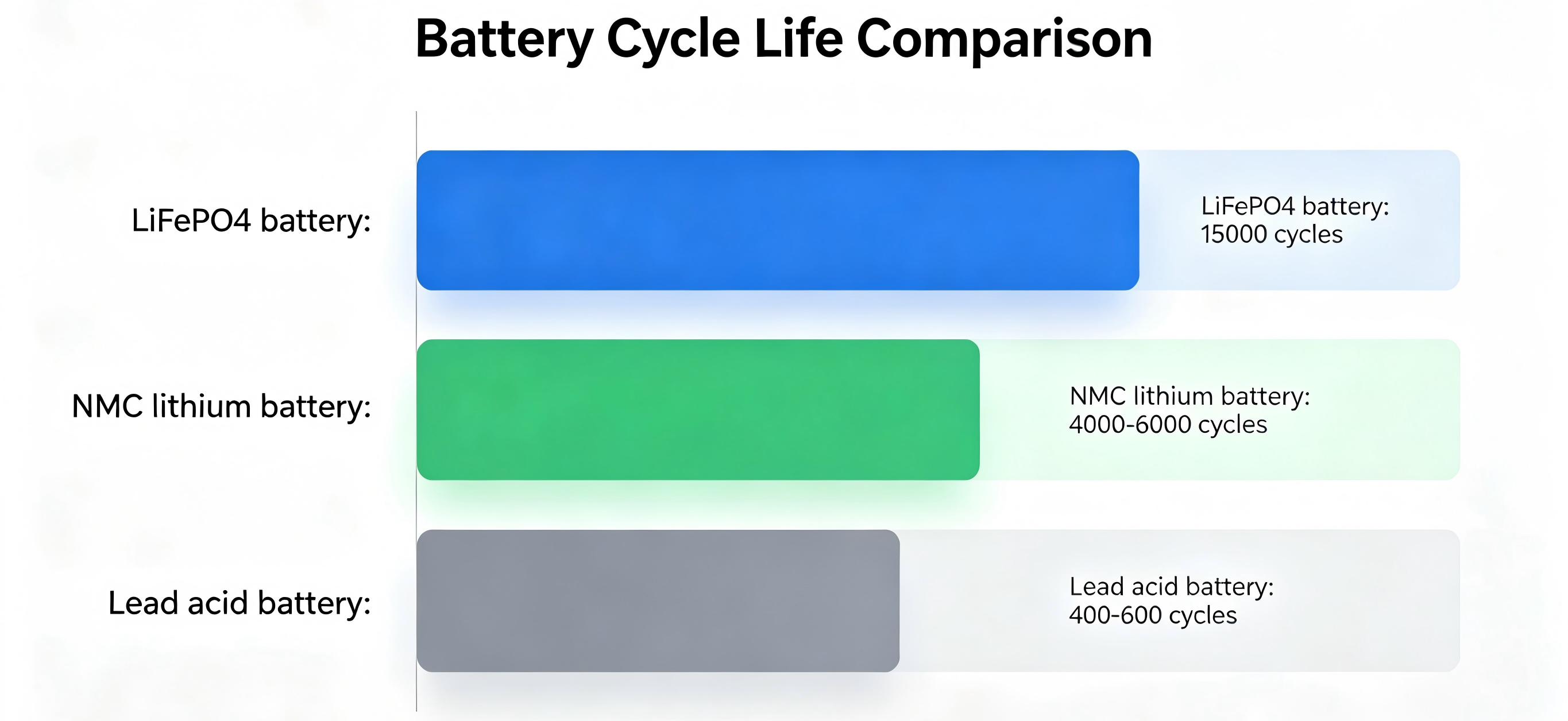
In actual daily use, high-quality LiFePO4 batteries can steadily serve you for more than 10 years. On the contrary, lead-acid batteries need to be replaced every 3 to 5 years due to limited cycle times. In terms of long-term use return, LiFePO4 batteries have absolute overwhelming advantages.
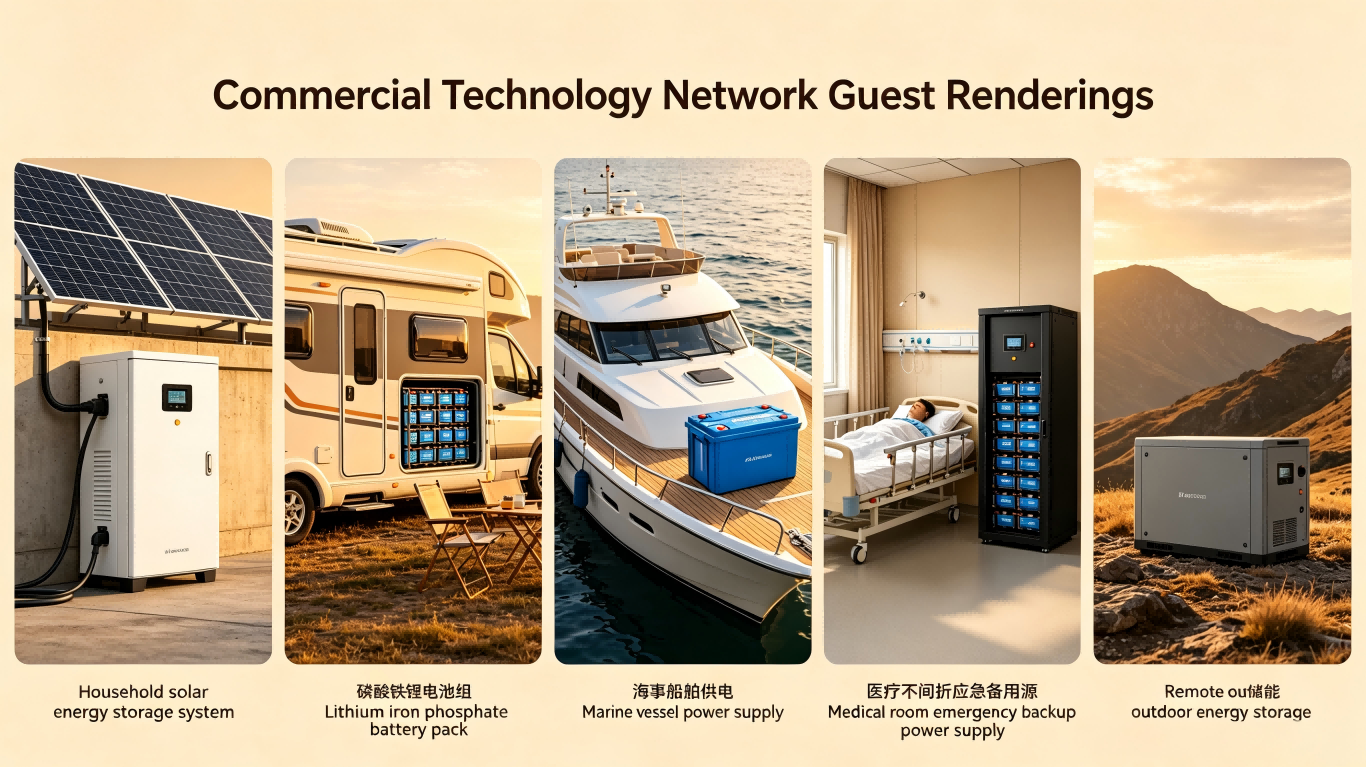
Excellent lifespan and stable performance have made LiFePO4 batteries widely used in various fields around the world, and have been fully verified in actual long-term operation scenarios.
Many independent solar households in North America and Europe choose LiFePO4 battery packs to match off-grid photovoltaic systems. After more than 12 years of uninterrupted daily charge and discharge operation, these batteries still retain more than 80% of the initial power capacity.
A large number of self-driving RV owners and yacht users prefer to install LiFePO4 batteries as mobile power supply equipment. In complex environments, LiFePO4 batteries can operate stably for more than 10 years. It is 50% lighter than lead-acid batteries and fully sealed to avoid leakage.
Many new energy passenger cars and urban public electric buses adopt LFP batteries. In daily high-frequency operation, the battery can maintain stable output for more than 8 years with remaining capacity higher than 90%.
In hospitals and core data centers, LiFePO4 batteries provide emergency standby power with up to 15 years of standby life and perfect BMS intelligent protection.
In remote areas far from the grid, maintenance-free LiFePO4 batteries adapt to harsh climates, no regular inspection needed, greatly reducing operation difficulty and cost.
Many users hesitate due to the higher initial price of LiFePO4 batteries. But calculated within 10 years, LiFePO4 is far more cost-effective.
Compared with lead-acid batteries, the core cost differences are as follows:
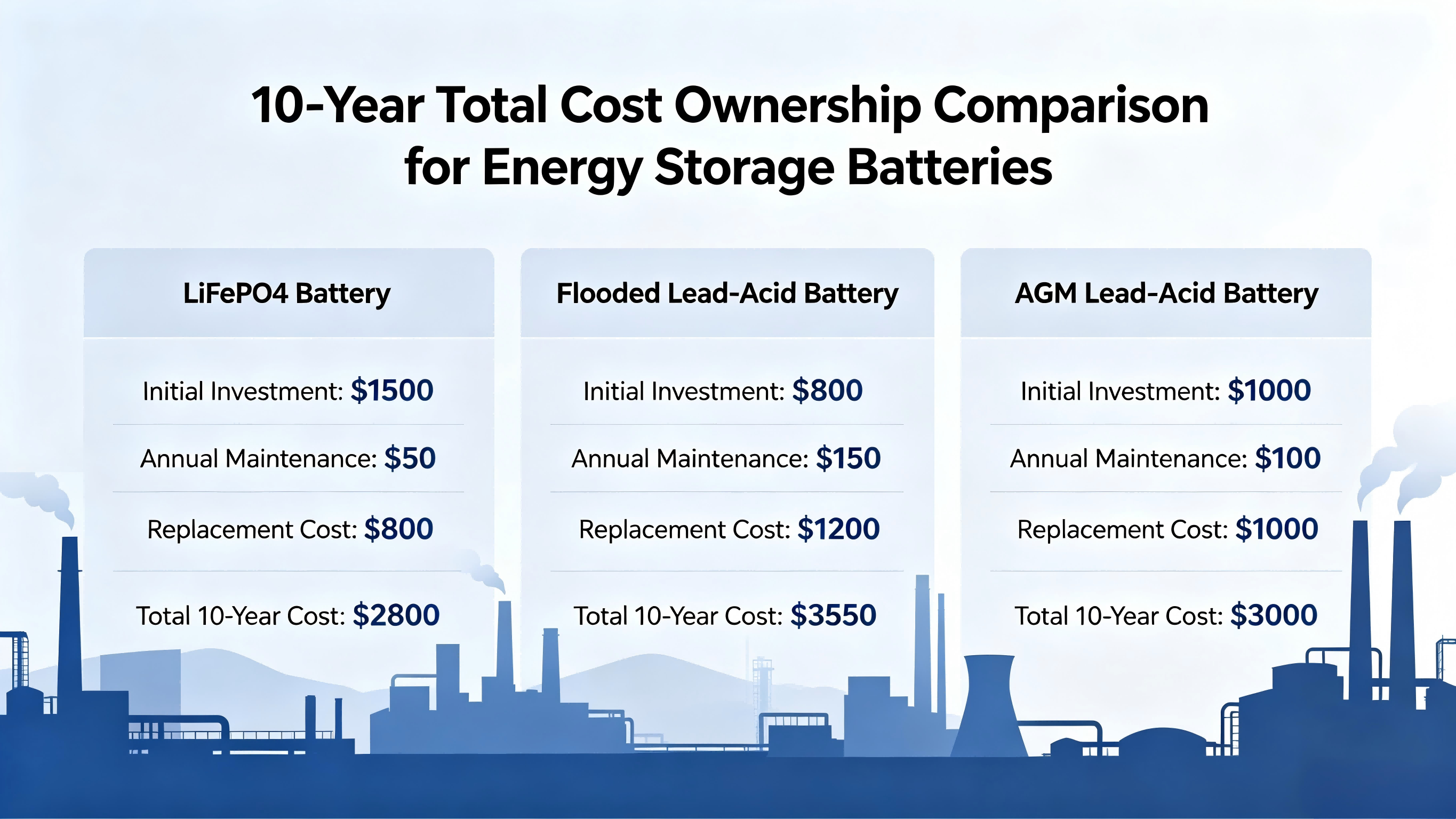
In addition to economic cost savings, the ultra-long service life of LiFePO4 batteries also brings many practical convenient advantages to users. Fewer replacements mean less system downtime, fit-and-forget maintenance-free mode, and less hazardous waste discharge, which is more environmentally friendly.
All rechargeable batteries will have capacity attenuation after long-term use, but LiFePO4 batteries age slowly and linearly with almost no sudden failure. They maintain over 95% round-trip efficiency and extremely small internal resistance changes for most of their life.
The popularization of long-life LiFePO4 batteries strongly promotes the rapid development of global renewable clean energy. It balances solar and wind power instability, provides stable energy buffer, and supports grid peak shaving and frequency regulation. All materials are eco-friendly and recyclable.
From service life, safety performance, use experience and long-term comprehensive cost, LiFePO4 batteries are undoubtedly the most ideal long-term energy storage battery choice at present.
Whether you are building a household solar system, equipping RVs and yachts, or arranging commercial backup power, LiFePO4 provides stable, safe and worry-free power supply for more than 10 years. It is the wisest one-time investment for long-term use.
Q1: What is the ideal storage state for idle LiFePO4 batteries?
A1: Store at 50%–60% charge in dry, cool places. Avoid long-term full or empty storage to extend lifespan.
Q2: Can LiFePO4 work normally in cold northern regions?
A2: Yes. LiFePO4 has great low-temperature adaptability. Dedicated low-temperature models are available for extreme cold areas.
Q3: Do I need a dedicated charger for LiFePO4 batteries?
A3: Yes. A professional LiFePO4 charger protects cells and BMS, maximizes cycle life and avoids overcharging damage.
Q4: Will frequent shallow discharge shorten lifespan?
A4: No. Shallow cycles help prolong life. Control discharge within 80% for daily use.
Q5: Are used LiFePO4 batteries easy to recycle?
A5: Yes. No harmful heavy metals, high recycling value, low pollution.
Q6: Can I expand capacity later?
A6: Yes. Parallel connection with same voltage, capacity and brand is supported for flexible upgrade.
We supply high-standard LiFePO4 batteries with CE, UN38.3, RoHS certifications and built-in intelligent BMS. Full 12V/24V/48V models & OEM/ODM customization are available for solar, RV, marine and industrial applications.
Need professional battery support? Our expert team is ready to help
Email: info@bak-tech.com | Tel: +86 138 2871 3564


 Hotline
 Email
Email
 Address
RM 2201, Longshenghengbo Center, Jianshe East Road and Bulong Road Intersection, Longhua District, Shenzhen, Guangdong, China
B13 Bldg, Lihe Zijing Science and Technology Innovation Center Headquarters, No. 55, Qinghu East Road, Qingxi Town, Dongguan City, Guangdong Province, P.R. China


 Previous