

May 22, 2026 |BAKTH
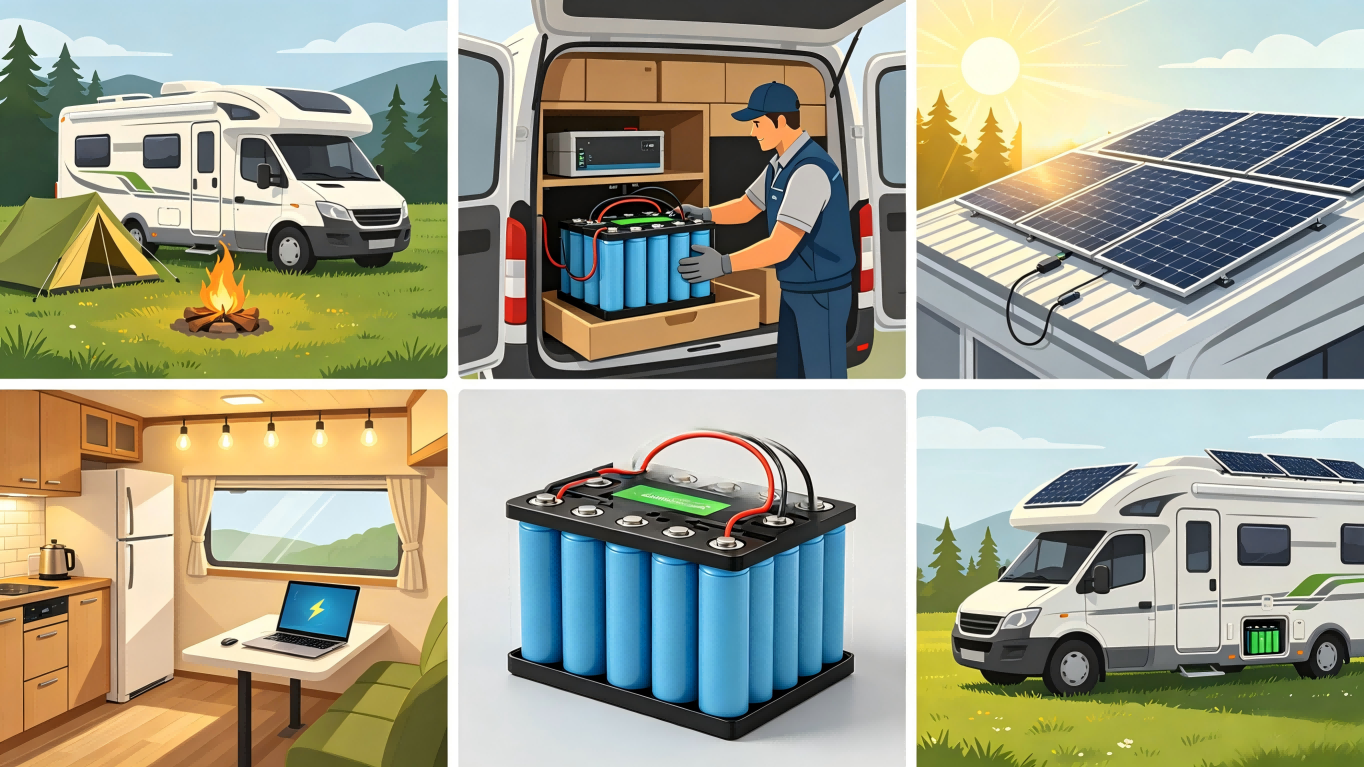
For RV campers, overlanding lovers and off-grid travelers, stable power supply defines the whole outdoor experience. Traditional lead-acid batteries become a common bottleneck during road trips, causing dim interior lights, frequent power shortage and noisy generator running that ruins peaceful camping nights.
Converting old lead-acid batteries to LiFePO4 lithium batteries is a practical and high-value upgrade. It greatly boosts power efficiency, extends service lifespan and delivers more comfortable off-grid living.
| Performance Item | Lead-Acid | LiFePO4 | Upgrade Advantage |
|---|---|---|---|
| Usable DOD Capacity | 50% | Up to 95% | 100Ah = 200Ah lead-acid |
| Cycle Life | 300–500 | 3000–5000+ | 10x longer life |
| Weight & Size | Heavy | 50–70% Lighter | Save space & reduce load |
| Charging Speed | Slow | 4–5x Faster | Less generator use |
| Maintenance | High | Maintenance-Free | Zero daily care |
| Voltage Stability | Drops sharply | Steady | Smoother appliance operation |
One-time investment matches RV lifespan
Maximize usable capacity and efficiency
Lightweight improves driving and storage
Fast charging reduces generator reliance
Stable voltage for all electronics
Eco-friendly, safe, low failure rate
Higher upfront cost
May require charger/converter upgrade
Low-temperature charging protection requiredCheck voltage, cables, fuses, breakers
Verify charger/converter compatibility
Replace voltage-based monitor with shunt-type SOC monitor
Choose UL, CE, UN38.3 certified batteries
Ensure good ventilation and secure mounting
Confirm warranty and insurance impact
12V: Most common, direct replacement
24V / 48V: For high-power loads, thinner cables
Rule: Only series/parallel identical batteries
Formula: Energy (Wh) = Voltage (V) × Capacity (Ah)
Total energy must exceed daily consumption + buffer. Choose expandable batteries.
100Ah: Weekend camping
200Ah: Most full-time RVers
Self-heating: Cold climates
Bluetooth: App monitoring
Replace lead-acid charger with LiFePO4-compatible smart charger
Use MPPT solar controller with lithium profile
Charge current: 20–40% of battery capacity
Install shunt-based monitor for accurate SOC
Bluetooth/WiFi for remote monitoring
Use proper cable gauge to avoid voltage drop
Copper lugs + heat shrink for connections
Install fuse near battery positive
Secure batteries to prevent movement
Allow ventilation for heat dissipation
| Failure Symptom | Probable Cause | Solution |
|---|---|---|
| Battery cannot charge normally | BMS protection / blown fuse | Warm battery / replace fuse |
| No power discharge output | Overcurrent / low voltage | Recharge / reset breaker |
| Dramatic voltage drop | Thin cables / loose connections | Upgrade cables / tighten lugs |
| Inaccurate SOC display | Shunt miswired / uncalibrated | Rewire / full charge calibration |
Cost includes: Battery, charger, monitor, cables, hardware, labor.
ROI: One LiFePO4 replaces 5–10 lead-acid sets. Less fuel, quieter camping, higher RV resale value.
Myth 1: Lead-acid chargers can’t work at all. Fact: Emergency only.
Myth 2: Lithium batteries explode easily. Fact: LiFePO4 is extremely safe.
Myth 3: Must remove entire old system. Fact: Recommended, not mandatory.
Mistake: Mix lead-acid and lithium. Result: Damage both batteries.
Essential Tools: Digital multimeter, hydraulic crimping pliers, wire stripper, socket wrench, torque wrench, heat shrink gun, heavy-duty cable cutter.
High-power RV: Use 24V/48V + DC-DC for 12V loads
Intelligent relay: Auto-cut non-essential loads at low SOC
Auto transfer switch: Smooth solar/generator/shore power switching
Modular design: Reserve space for future capacity expansion
Q1: Can 12V LiFePO4 directly replace 12V lead-acid?
A: Yes physically. For best life, upgrade charger and monitor.
Q2: Will 14.4V charger damage lithium batteries?
A: No immediate damage, but causes undercharging. Use LiFePO4 dedicated charger.
Q3: Can lithium run RV air conditioner?
A: Yes, with 300–400Ah battery and 2000–3000W inverter.
Q4: How to charge in cold winter?
A: Use self-heating batteries or install inside heated area.
Q5: Can I mix lead-acid and lithium?
A: Not recommended. Different chemistries damage both.
Q6: How to expand capacity later?
A: Add identical batteries in parallel.
Upgrading to LiFePO4 is one of the most valuable RV modifications you can make. It eliminates power shortages, provides quiet off-grid power, and lasts for years.
Choose premium BAKTH LiFePO4 batteries for stable performance, safety, and peace of mind on every trip.
Certified, safe, and built for RV, camping, and overlanding. Full-protection BMS, cold-resistant heating models, and Bluetooth monitoring available.
BAKTH | Professional LiFePO4 Battery Manufacturer
Email: info@bak-tech.com | Tel: +86 138 2871 3564


 Hotline
 Email
Email
 Address
RM 2201, Longshenghengbo Center, Jianshe East Road and Bulong Road Intersection, Longhua District, Shenzhen, Guangdong, China
B13 Bldg, Lihe Zijing Science and Technology Innovation Center Headquarters, No. 55, Qinghu East Road, Qingxi Town, Dongguan City, Guangdong Province, P.R. China


 Previous