

Jun 03, 2026 |BAKTH
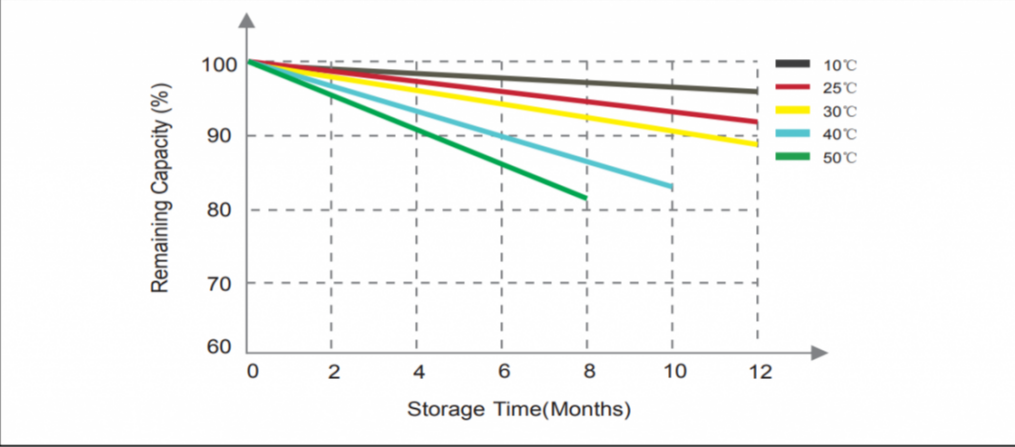
All rechargeable batteries rely on reversible internal chemical reactions to generate electricity, and ambient temperature directly speeds or slows these reactions.
- Low temperatures: Electrolyte thickens, lithium ion internal resistance spikes and slows ion migration between electrodes, cutting down real-world battery available capacity. Lead-acid suffers far worse capacity decline than standard LiFePO4 battery performance by temperature.
- High temperatures: Chemical activity accelerates for a temporary capacity boost, yet extra side reactions damage inner materials, triggering permanent high temperature battery degradation and faster self-discharge.
All battery rated capacities are tested under the global standard of 25°C (77°F); any temperature deviation will shift usable output.
This industry-standard table shows capacity fluctuation against 25°C baseline, categorized by discharge duration for RV and off-grid solar sizing:
| Discharge Duration | 0°C | 5°C | 10°C | 15°C | 20°C | 25°C | 30°C | 35°C | 40°C |
|---|---|---|---|---|---|---|---|---|---|
| <30 Min | -20% | -15% | -12% | -8% | -3% | 0% | +5% | +8% | +10% |
| 30–60 Min | -18% | -13% | -11% | -7% | -2% | 0% | +4% | +6% | +8% |
| >60 Min | -16% | -12% | -10% | -6% | -1% | 0% | +3% | +4% | +5% |
Key reference values: Lead-acid loses ~20% capacity at 0°C and nearly 50% at -27°C; 50°C brings 10–15% short-term capacity rise but accelerates aging sharply.
Poor low-temperature performance with massive capacity drop below freezing; high self-discharge under warmth, best suited for indoor fixed equipment.
Balanced cold resistance, prone to accelerated aging under continuous high heat, widely used in portable power devices.
Top-tier thermal stability with mild cold capacity loss, the preferred option to solve RV battery temperature issues and optimize solar storage battery thermal management. Note: standard LiFePO4 cannot be charged below 0°C to avoid lithium plating damage.
Per the proven Arrhenius rule battery lifespan, every 10°C rise over the ideal 25°C doubles internal corrosive reactions and halves expected service life.
Practical example: A 15-year expected lifespan at 20°C falls to only 7.5 years under steady 30°C working conditions.
Important reminder: Temporary capacity gain from high heat never offsets irreversible long-term cell degradation.
Large-capacity solar and ESS packs feature substantial battery thermal mass, so inner cell temperature adjusts much slower than surrounding air. For instance, ambient temperature may swing from 20°C to 70°C daily, while insulated large battery bank inner temp varies only ~10°C. Install insulated thermocouples on positive terminals to capture accurate internal temperature readings.
High storage heat is the leading cause of wasted inventory for battery distributors; below verified monthly self-discharge metrics for mainstream chemistries:
8°C: 2%/month | 20°C: 3%/month | 30°C: 5%/month | 40°C: 10%/month
8°C: 6%/month | 20°C: 9%/month | 30°C: 15%/month | 40°C: 30%/month
Ultra-low self-discharge: 1~3% monthly at room temp, under 5% even at 40°C, a core advantage for scientific bulk battery storage tips.
Inventory rule: Never let stored batteries drop below 45~50% SOC; top up charge periodically to prevent permanent capacity loss.
Based on BAKTH global client feedback, temperature-related capacity loss creates these frequent commercial headaches:
Maintain warehouse within 15~25°C (optimal battery operating temperature), away from direct sunlight and heat sources; pre-store all batteries at 40~60% SOC and inspect every 2–3 months.
Place battery banks inside insulated cabins instead of exposed outdoor compartments; equip charging systems with temperature-adjustable chargers. Choose low-temperature customized LiFePO4 for frigid-area projects.
Add surrounding ventilation for battery racks to reduce sustained high ambient temperature and slow thermal aging.
A: 20°C~25°C (68~77°F), matching official capacity testing criteria for all mainstream batteries.
A: Regular LiFePO4 blocks charging below 0°C to avoid plating; customized heated LiFePO4 supports low-temperature charging for cold regions.
A: Higher temperature drastically lifts monthly self-discharge; follow standardized bulk storage guidelines to control losses.
A: Yes, reference the capacity temperature chart and add 20~30% extra capacity to offset winter capacity drop.
A: It automatically modifies charging voltage with cell temperature, effectively protecting LiFePO4 battery performance by temperature year-round.
Temperature dominates real-world battery available capacity and overall service life. Lead-acid is sensitive to extreme cold and heat, whereas LiFePO4 delivers stable performance across wider climate ranges and dominates outdoor RV and solar applications.
As a direct lithium manufacturer, BAKTH supplies customized low-temp resistant LiFePO4, NMC, 18650 and LiPo cells for global B2B clients. We provide climate-targeted product suggestions and bulk pricing upon your inquiry.
Custom low-temp LiFePO4, stable thermal performance, long lifespan for RV, solar & outdoor projects.
BAKTH | Professional Lithium Battery Manufacturer
Email: info@bak-tech.com | Tel: +86 138 2871 3564


 Hotline
 Email
Email
 Address
RM 2201, Longshenghengbo Center, Jianshe East Road and Bulong Road Intersection, Longhua District, Shenzhen, Guangdong, China
B13 Bldg, Lihe Zijing Science and Technology Innovation Center Headquarters, No. 55, Qinghu East Road, Qingxi Town, Dongguan City, Guangdong Province, P.R. China


 Previous