

Jun 01, 2026 |BAKTH
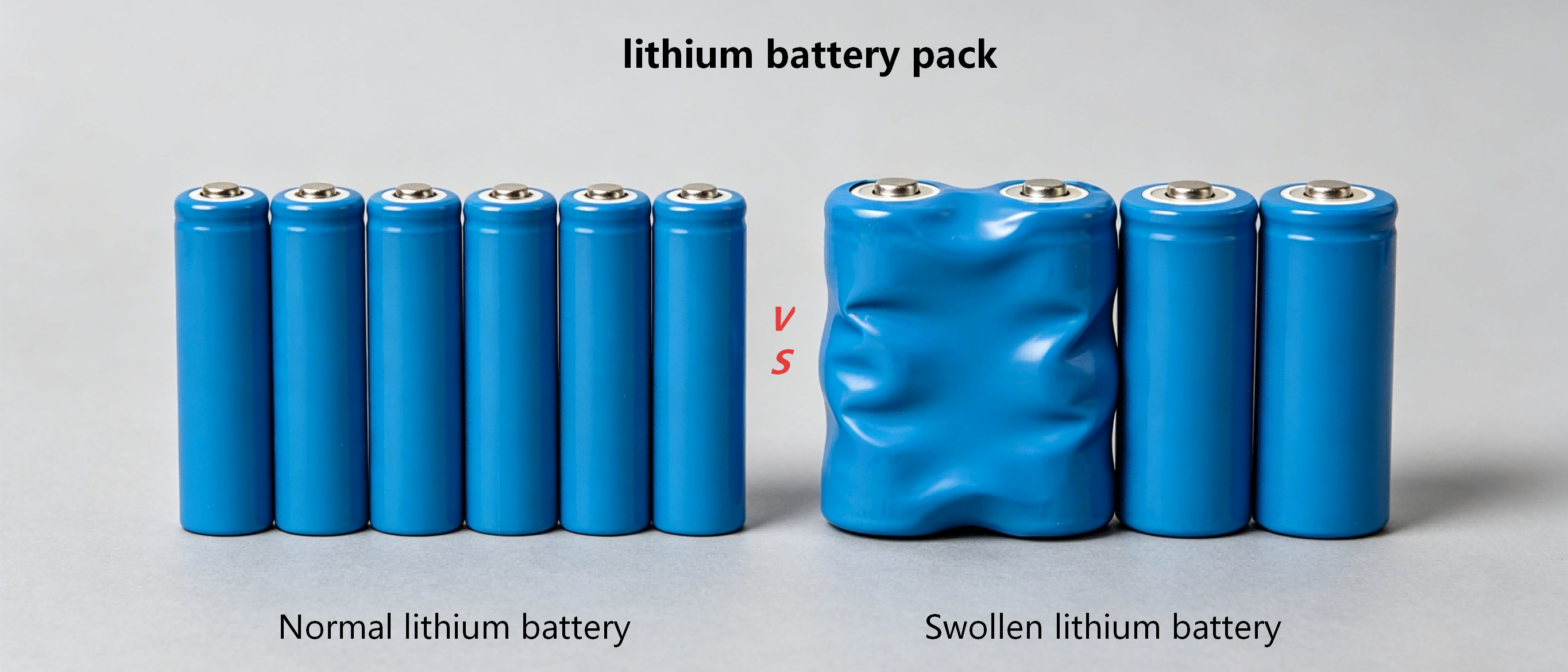
Lithium battery swelling or bulging occurs when excessive gas accumulates inside sealed battery cells, raising internal pressure and deforming the casing. Normal chemical reactions during charge and discharge produce negligible gas, but abnormal operation or poor cell quality will lead to rapid gas buildup.
This issue happens across all mainstream battery types in the industry: cylindrical 18650 batteries, soft-pack LiPo batteries, prismatic LiFePO4 batteries and assembled lithium-ion battery packs. For B2B operations, this is never just a minor product defect — it is a hidden risk to your entire business.
We communicate with hundreds of overseas B2B clients every year, and these are the most frequent frustrations shared by wholesale buyers, pack assemblers and distributors regarding bulging lithium batteries:
Many buyers receive good feedback at the time of delivery, but start getting customer complaints weeks or months later. End users report lithium battery swelling on power tools, wearable devices, RV batteries and solar storage systems. You have to handle endless return requests, product replacements and refund negotiations, which eats up your labor and time costs.
Bulk defective batteries that develop bulges while sitting in your warehouse cannot be resold. You face direct inventory waste and capital loss. Worse still, stacked swollen lithium batteries bring fire and leakage risks, forcing you to rearrange storage areas and increase safety management costs.
In the competitive lithium battery market, product reliability is the core of long-term cooperation. If your clients repeatedly encounter battery bulging problems, they will lose trust in your supply chain. You may lose regular customers, receive negative reviews, and even struggle to expand new distribution channels.
To avoid receiving defective goods, you have to arrange extra pre-shipment inspection, random sampling and performance testing for every new batch. Additional testing procedures slow down your delivery cycle and increase operational expenses. Some buyers also need to rework unqualified battery packs, which further raises production costs.
Local waste management regulations strictly restrict the disposal of damaged lithium batteries. Once you have a large number of swollen cells on hand, you need to pay extra fees for professional recycling. It is both troublesome and costly to comply with regional environmental and safety rules.
For buyers who customize series/parallel battery packs, inconsistent cell quality is a major nightmare. A few defective cells will swell first during use, drag down the performance of the entire pack, and cause the whole set to fail prematurely. This problem is especially prominent in large-capacity LiFePO4 battery packs for RV and solar projects.
To solve the above troubles fundamentally, let’s break down the six core causes of lithium battery swelling, covering product quality, matching accessories and end-user usage:
Overcharging is the primary trigger for battery bulging. Every type of lithium battery has a fixed safe charging voltage. Unmatched chargers or faulty BMS will keep charging cells beyond the limit, decompose the electrolyte and generate massive gas. Many low-cost battery products are equipped with inferior BMS, which cannot cut off power in time and leads to batch swelling.
When batteries are drained down to 0V for a long time, the internal electrode structure is permanently damaged. During recharging, violent chemical reactions produce gas. This issue often appears on idle RV batteries and solar lithium battery packs that stay uncharged for months. It is also a common problem for end users who lack proper usage guidance.
Heat accelerates electrolyte decomposition greatly. End users may leave devices under direct sunlight, inside high-temperature vehicles, or run high-power loads continuously. LiPo batteries and ordinary lithium-ion cells are particularly sensitive to heat, and swelling will occur after long-term high-temperature operation.
Long-distance ocean shipping, rough loading and unloading, or improper installation will cause extrusion, impact and bending to batteries. Soft Li-polymer batteries and thin battery casings are easy to be damaged internally, forming hidden short circuits and gradual bulging after several charge cycles.
Cheap inferior cells have short cycle life and fast performance degradation. After dozens or hundreds of charge cycles, internal resistance rises sharply, chemical reactions become unstable, and swelling occurs in batches. This is why many budget battery products cannot maintain stable performance in long-term bulk sales.
Unqualified production processes, impure raw materials and uneven electrode coating will create defective cells at the factory end. For assembled packs, mismatched cells with inconsistent voltage and capacity will cause imbalance during operation. Individual cells are overcharged or over-discharged secretly, eventually making the whole pack bulge.
For B2B buyers, swollen lithium batteries are not just simple product defects, but multi-dimensional business risks:
No matter you deal with 18650 cells, LiPo batteries or large LiFePO4 energy storage packs, these risks cannot be ignored.
As a reliable lithium battery factory, we summarize targeted solutions to help B2B buyers cut down swelling issues from procurement, storage, sales to after-sales:
Choose suppliers with strict quality control and complete certifications. All BAKTH batteries adopt high-purity raw materials, rigorous cell sorting and full testing procedures. Every finished pack is built with standard BMS to prevent overcharge, over-discharge and overheating, greatly reducing the swelling rate at the source.
Provide end users with dedicated chargers matching lithium-ion, LiFePO4 or LiPo batteries. Avoid mixing universal low-quality chargers. For custom packs, configure BMS with complete protection functions to stabilize voltage and current during operation.
Attach clear user manuals to bulk orders, reminding end users to avoid overcharging, deep discharge and high-temperature use. Professional usage guidance can effectively reduce artificial damage and related after-sales problems.
Check stored batteries regularly. Once you find individual swollen cells, isolate and dispose of them immediately to prevent chain risks. For long-term stock, keep batteries at 40%~60% SOC to slow down aging.
A: Yes. LiFePO4 batteries feature excellent chemical and thermal stability. Under normal use, the probability of bulging is far lower than conventional lithium-ion and LiPo batteries, making them a safer choice for bulk sales and long-term projects like RV and solar storage.
A: The main reasons are inconsistent cell sorting, inferior BMS protection, mismatched chargers or poor packaging during transit. It is recommended to cooperate with factories that support pre-assembly testing and strict cell matching.
A: Absolutely not. Even minor bulges mean internal chemical abnormalities. Selling such products will bring huge after-sales and safety risks to you and your downstream customers.
A: Start from three aspects: select high-quality factory products, equip complete protection accessories, and deliver detailed user guides to end users. Stable quality is the most effective way to cut after-sales troubles.
A: Yes. As a direct manufacturer, we offer formal quality warranties for all 18650 cells, Li-polymer batteries, lithium-ion packs and LiFePO4 batteries. We strictly control every production link to minimize defective rates and support reasonable after-sales processing for B2B partners.
Lithium battery swelling is a universal pain point for every B2B buyer in the battery industry. It brings return pressure, inventory loss, safety risks and brand damage, which directly affects your long-term business development.
The fundamental solution is to control quality from the source: cooperate with professional and reliable lithium battery factories, select qualified cells and complete protection solutions, and standardize transportation, storage and user usage rules.
BAKTH is a direct manufacturer integrating R&D, production and sales, focusing on 18650 cells, lithium-ion batteries, LiPo batteries and LiFePO4 batteries. We serve global wholesalers, distributors, pack assemblers and engineering clients, with strict quality inspection, stable product performance and thoughtful B2B service.
If you are looking for low-defect-rate lithium battery supplies to reduce after-sales troubles and expand your business, welcome to contact our team for product catalog, testing reports and wholesale quotation.
Certified safe cells, strict quality control, stable BMS protection, minimal swelling & after-sales risks for bulk B2B orders.
BAKTH | Professional Lithium Battery Manufacturer
Email: info@bak-tech.com | Tel: +86 138 2871 3564


 Hotline
 Email
Email
 Address
RM 2201, Longshenghengbo Center, Jianshe East Road and Bulong Road Intersection, Longhua District, Shenzhen, Guangdong, China
B13 Bldg, Lihe Zijing Science and Technology Innovation Center Headquarters, No. 55, Qinghu East Road, Qingxi Town, Dongguan City, Guangdong Province, P.R. China


 Previous