Introduction: Why Battery Degradation Matters for Your Bottom Line
Battery degradation—the gradual, irreversible loss of capacity, power, and efficiency over time—is the single biggest threat to your lithium battery investment. For B2B buyers, this means unexpected downtime, increased replacement costs, and damaged customer trust.
Lithium-ion batteries typically lose 1–3% of capacity annually under ideal conditions. Poor operation and storage can accelerate this to 5–10% per year, turning a 5-year lifespan into 2–3 years.
In this guide, we break down the science of degradation, its business impacts, and actionable strategies to maximize battery life. Whether you source 18650 cells, LiFePO4 packs, or custom lithium solutions, this knowledge will help you reduce total cost of ownership (TCO) and ensure long-term reliability for your clients.
What Is Battery Degradation? The Science Behind the Loss
Battery degradation is a complex chemical and physical aging process that occurs during both use and storage. It’s not about “running out of juice”—it’s about irreversible changes inside the cell that reduce performance over time.
Core Microscopic Mechanisms
- SEI Layer Growth: A solid electrolyte interphase (SEI) forms on the anode during charging. While protective, it thickens over cycles, consuming active lithium and increasing internal resistance.
- Lithium Plating: Fast charging or low temperatures cause lithium metal to deposit on the anode instead of intercalating. This creates “dead lithium,” reduces capacity, and raises short-circuit risks.
- Electrode Cracking: Repeated expansion/contraction during cycling causes microscopic cracks in cathode/anode materials, breaking electrical connections and losing active mass.
- Electrolyte Decomposition: High voltages or heat break down the electrolyte, forming gas and reducing ion conductivity.
Key Metrics of Degradation
- Capacity Fade: The most visible sign—your battery holds less energy, leading to shorter runtime.
- Increased Internal Resistance: Slower charging, voltage drops under load, and more heat generation.
- State of Health (SOH): A critical B2B metric—current capacity vs. original capacity. SOH<80%indicates end-of-life for most applications.
- Cycle Count: Lithium-ion batteries deliver 500–2,000 full cycles before reaching 80% SOH, depending on chemistry and usage.
Top 5 Causes of Accelerated Battery Degradation (And How to Avoid Them)
1. Extreme Temperatures (#1 Killer of Lithium Batteries)
- High Heat (>35°C/95°F): Accelerates SEI growth, electrolyte breakdown, and cathode dissolution. Each 10°C rise doubles degradation rate.
- Cold (<0°C/32°F): Slows lithium ion movement, increases resistance, and triggers lithium plating during charging.
- Optimal Range: 15°C–35°C (59°F–95°F) for operation; 20°C–25°C (68°F–77°F) for storage.
2. Poor State of Charge (SOC) Management
- 100% Charge (Full): High voltage stresses the battery, accelerates SEI growth, and increases swelling risk.
- 0%–20% Charge (Deep Discharge): Causes severe anode stress and irreversible capacity loss.
- The 40–80 Rule: Keep SOC between 40%–80% for daily use. This “sweet spot” minimizes chemical stress and extends cycle life by 30–50%.
3. Frequent Fast Charging & High C-Rates
Fast charging (≥1C) generates excess heat and triggers lithium plating. High discharge rates (>2C) increase internal resistance and accelerate capacity fade.
Best Practice: Use 0.3C–0.5C charging for daily operation; reserve 1C+ only for emergencies.
4. Deep Discharges (High DoD)
Depth of Discharge (DoD) = % of capacity used. 100% DoD (full drain) causes extreme electrode stress.
- 100% DoD: 500–800 cycles
- 70% DoD: 1,000–1,500 cycles
- 50% DoD: 2,000+ cycles
5. Long-Term Storage Mistakes
- Full Charge Storage: Batteries at 100% SOC age 2–3x faster than at 50%.
- Empty Storage: 0% SOC leads to irreversible deep discharge damage.
- Correct Storage: 40%–60% SOC, 15°C–25°C, and recharge every 3–6 months.
Degradation Rates by Battery Chemistry: What B2B Buyers Need to Know
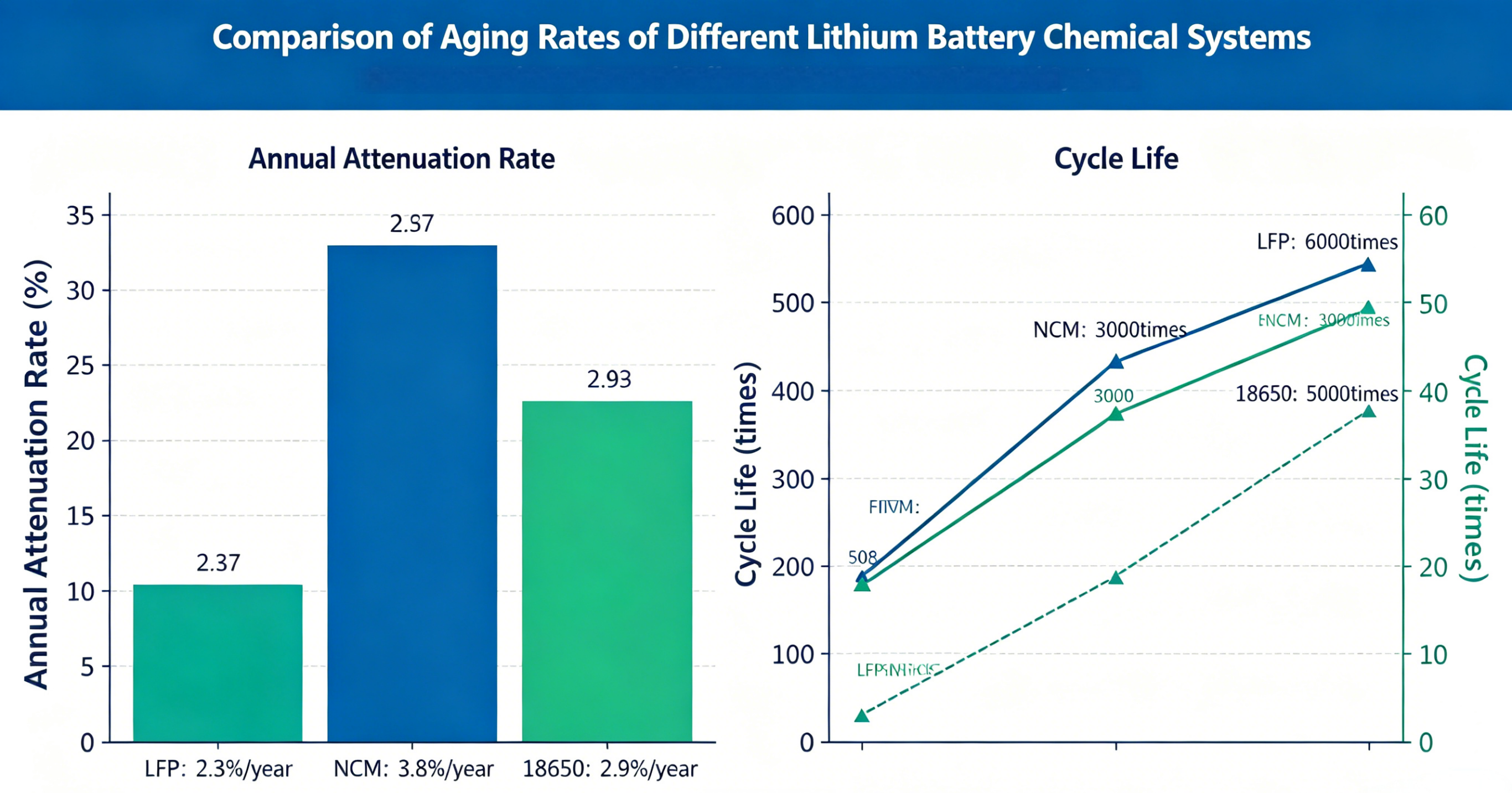
Not all lithium batteries age the same. Choose the right chemistry for your application to minimize degradation:
| Chemistry | Annual Degradation | Cycle Life (80% SOH) | Best For |
|---|
| LiFePO4 (LFP) | 1%–2% | 2,000–4,000 | Energy storage, EVs, long-cycle applications |
| NCM/NCA | 2%–3% | 1,000–2,000 | High-density applications (e-bikes, drones) |
| 18650 (Generic) | 2%–4% | 500–1,000 | Low-cost, disposable applications |
| Lead-Acid | 4%–6% | 300–500 | Legacy systems (avoid for new projects) |
Key Takeaway: For B2B buyers prioritizing longevity and low TCO, LiFePO4 is the clear choice. It has the lowest degradation rate and longest cycle life, despite lower energy density than NCM.
Business Impacts of Ignoring Degradation: Hidden Costs for B2B Buyers
- Increased Replacement Costs: Batteries that degrade fast need frequent replacement, raising TCO by 20–40%.
- Downtime & Lost Revenue: Unexpected battery failure halts operations (e.g., e-bike fleets, solar storage), leading to lost sales and customer penalties.
- Reputational Damage: Supplying low-quality, fast-degrading batteries erodes client trust and hurts long-term partnerships.
- Safety Risks: Degraded batteries are prone to swelling, overheating, and even thermal runaway—creating liability risks for your business.
7 Actionable Strategies to Prevent Degradation & Maximize Battery Life
1. Implement Smart SOC Management
- Enforce the 40–80 Rule for daily operation.
- Avoid leaving batteries at 100% SOC for more than 24 hours.
- Use BMS to auto-limit charge to 80% and discharge to 20%.
2. Invest in Thermal Management
- For large packs, use active cooling/heating to maintain 15°C–35°C.
- Store batteries in climate-controlled warehouses; avoid direct sunlight or freezing areas.
3. Optimize Charging Practices
- Use 0.3C–0.5C standard charging for daily use.
- Avoid charging at temperatures <0°Cor >40°C.
- Unplug chargers once full; avoid trickle charging.
4. Limit Depth of Discharge (DoD)
- Cap DoD at 70% for most applications (discharge to 30% SOC).
- For long-term reliability, target 50% DoD (discharge to 50% SOC).
5. Use High-Quality BMS & Cell Balancing
- A robust BMS monitors SOC, SOH, temperature, and voltage in real time.
- Cell balancing ensures uniform performance across the pack, preventing weak cells from degrading faster.
6. Source High-Grade Cells (Avoid Fake/Refurbished)
- A+ Grade Cells: Stable capacity, low resistance, 500+ cycles.
- B Grade/Refurbished: High resistance, prone to swelling, <300 cycles.
- Red Flag: 18650 cells labeled >3500mAh are almost always fake; genuine 18650 maxes out at 3500mAh.
7. Train Your Team & Clients
- Educate staff on proper handling, storage, and charging.
- Provide clients with a battery maintenance guide to ensure they follow best practices.
Future Trends: Next-Gen Tech to Reduce Degradation
- Solid-State Batteries: Eliminate liquid electrolyte, reducing SEI growth and lithium plating. Expected to deliver 5,000+ cycles with minimal degradation.
- AI-Powered BMS: Machine learning optimizes charging/discharging in real time, predicting degradation and adjusting parameters to extend life.
- Self-Healing Materials: New electrode materials repair micro-cracks, slowing capacity fade.
- Modular Battery Packs: Replace individual degraded cells instead of the entire pack, reducing maintenance costs.
Conclusion: Protect Your Battery Investment With Proactive Degradation Management
Battery degradation is inevitable—but it’s controllable. By understanding the science, avoiding common mistakes, and implementing best practices, you can extend battery life by 50–100%, reduce TCO, and deliver reliable products to your clients.
For B2B buyers, the key is to prioritize quality over price, choose the right chemistry (LiFePO4 for longevity), and invest in proper management systems. Remember: a cheaper battery that degrades fast is more expensive in the long run.
Next Steps for Your Business
- Audit your current battery sourcing and usage practices.
- Switch to A+ Grade LiFePO4 cells for long-cycle applications.
- Implement 40–80 SOC and temperature control protocols.
- Train your team and clients on degradation prevention.
Ready to source high-quality, long-lasting lithium batteries? Contact us today to discuss your B2B needs.
Reliable Lithium Batteries With Low Degradation Rate
Premium A+ grade cells, strict quality control and stable performance to cut your long-term operational costs.
✅ Low Annual Degradation
✅ Long Cycle Life
✅ A+ Grade Cells Only
✅ Full Test Reports
BAKTH | Professional Lithium Battery Manufacturer & Supplier
Email: info@bak-tech.com | Tel: +86 138 2871 3564


 Hotline
 Email
Email
 Address


 Previous