

Apr 28, 2026 |BAKTH
If you’ve ever looked into lithium-ion batteries for power tools, electric vehicles (EVs), flashlights, or power banks, you’ve almost certainly encountered 18650 and 21700 cells. These two cylindrical lithium-ion formats dominate the rechargeable battery market—but which one is better for your project?
In this guide, we’ll break down every critical difference between 21700 and 18650 batteries, including size, capacity, energy density, performance, pros and cons, cost, and ideal applications. By the end, you’ll know exactly which cell to choose for your device.
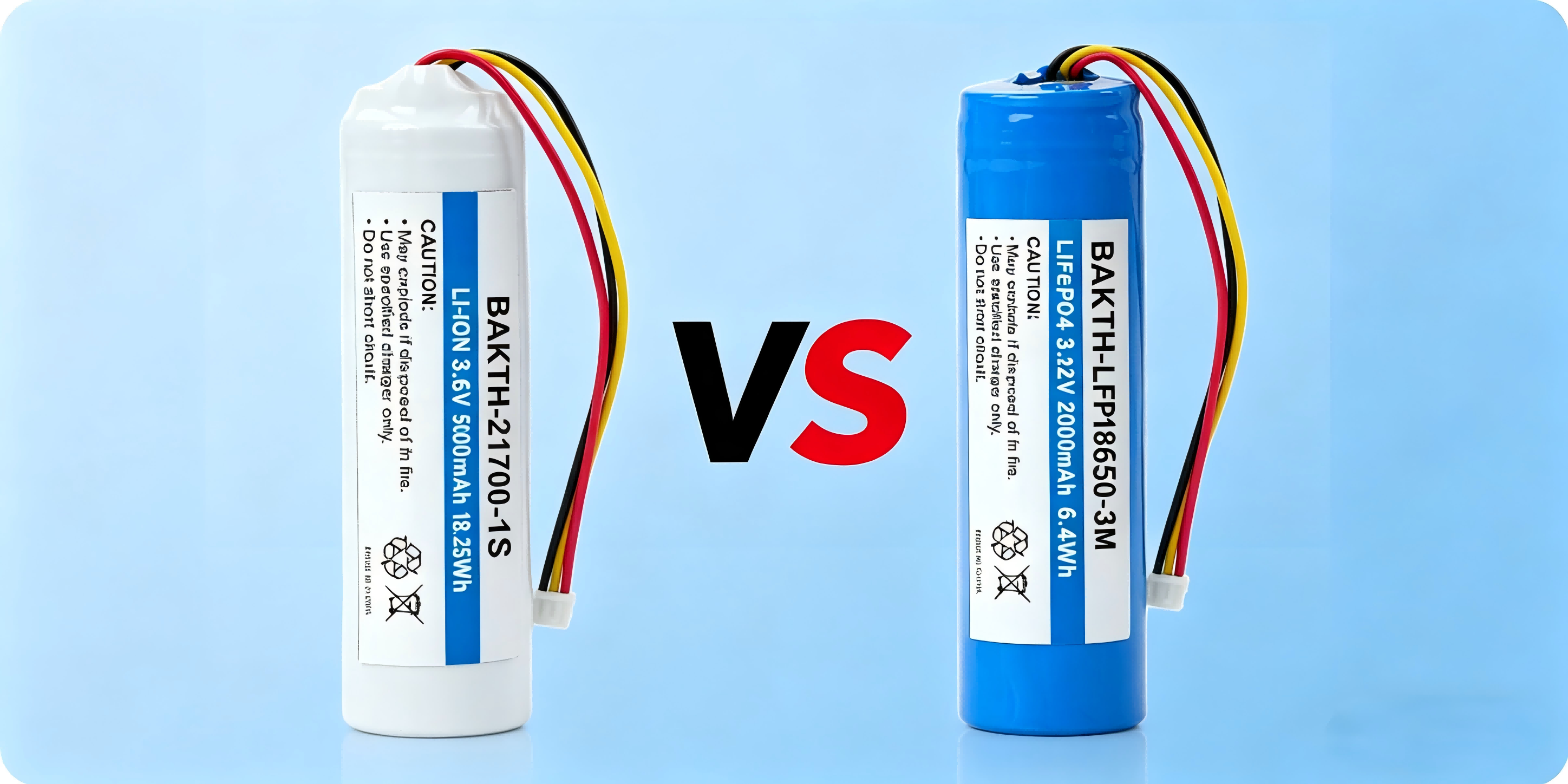
First, let’s clarify the basics: both are rechargeable cylindrical lithium-ion batteries with a nominal voltage of 3.6V–3.7V (4.2V fully charged, 2.5V–3.0V discharge cutoff). The numbers in their names refer to their physical dimensions (diameter × length, in millimeters):
This seemingly small size difference (3mm wider, 5mm longer) transforms nearly every aspect of their performance and use cases.
Let’s start with a side-by-side look at their key technical specs:
| Feature | 21700 Battery | 18650 Battery | Difference |
|---|---|---|---|
| Dimensions | 21mm × 70mm | 18mm × 65mm | Larger & heavier |
| Typical Capacity | 3000–5000mAh (up to 5100mAh) | 1800–3600mAh | +30–50% capacity |
| Energy Density | 250–300 Wh/kg | 200–250 Wh/kg | +20% higher |
| Continuous Discharge | 30A–50A (high-drain models) | 5A–30A (high-drain models) | Stronger power output |
| Cycle Life | 500–1500 cycles | 300–1000 cycles | Longer lifespan |
| Weight | ~70–80g | ~45–50g | Heavier |
| Cost Per Cell | Higher (+20–30%) | Lower | 18650 cheaper |
The 21700’s larger internal volume allows more active electrode materials and electrolyte, directly boosting capacity, energy density, and power handling.
To make your decision easier, here’s a clear breakdown of their advantages and disadvantages:
| Comparison Item | 21700 Lithium Battery | 18650 Lithium Battery |
|---|---|---|
| Core Advantages | ✅ Higher single-cell capacity & energy density ✅ Stronger high-current discharge (30–50A) ✅ Longer cycle life (500–1500 cycles) ✅ Better heat dissipation & thermal stability ✅ Fewer cells needed for battery packs | ✅ Smaller, lighter, compact design ✅ Lower cost & high cost-performance ✅ Universal compatibility (global standard) ✅ Mature supply chain & easy sourcing ✅ Faster charging for quick power-ups |
| Main Disadvantages | ❌ Larger & heavier (not for tiny devices) ❌ Higher per-cell cost ❌ Limited device compatibility ❌ Longer charging time (high capacity) ❌ Requires better pack cooling | ❌ Lower capacity (shorter runtime) ❌ Weaker high-power performance (heats faster) ❌ Shorter cycle life (300–1000 cycles) ❌ More cells needed for large packs ❌ Less stable under long-term high loads |
The most noticeable difference is capacity:
High-drain devices (EVs, power tools, high-lumen flashlights) demand continuous high current:
Heat is the biggest enemy of lithium batteries. The 21700’s larger size improves cooling:
Long-term value depends on how many charge cycles the battery lasts:
- 18650: 20–30% cheaper per cell → Lower upfront cost for small projects.
- 21700: Higher per-cell price but lower system cost for large packs. For example, a 100Ah battery needs 20×5000mAh 21700 cells vs. 30×3300mAh 18650 cells → Fewer parts, simpler assembly, and lower long-term maintenance. Tesla data shows 21700 systems cost ~$155/kWh vs. $171/kWh for 18650 → 9% lower cost per kWh.
Neither battery is “better” overall—it depends on your needs.
Choose 21700 if you want higher capacity, longer runtime, stronger power, and better durability for high-performance devices (EVs, power tools, large storage).
Choose 18650 if you need compact size, low cost, and wide compatibility for everyday electronics, budget tools, and space-constrained gear.
As the battery industry evolves, 21700 cells are becoming the future standard for high-energy applications, while 18650s remain the reliable, cost-effective choice for mainstream devices.
Q1: Can I replace an 18650 with a 21700 in my device?
A: No. They differ in physical size, voltage behavior, and discharge characteristics. Using the wrong cell may damage your device or cause safety hazards.
Q2: Are 21700 batteries safer than 18650?
A: Generally yes. 21700 cells run cooler under load, have lower internal resistance, and withstand higher temperatures—reducing overheating and fire risks.
Q3: Do 21700 batteries last longer than 18650?
A: Yes. 21700s offer 500–1500 cycles vs. 300–1000 cycles for 18650s → 30–50% longer lifespan.
Q4: Are 21700 batteries worth the extra cost?
A: For high-performance/high-drain applications (EVs, power tools), yes—the long-term savings from fewer cells, longer life, and better performance justify the upfront cost. For budget/light-use devices, 18650s are more cost-effective.


 Hotline
 Email
Email
 Address
RM 2201, Longshenghengbo Center, Jianshe East Road and Bulong Road Intersection, Longhua District, Shenzhen, Guangdong, China
B13 Bldg, Lihe Zijing Science and Technology Innovation Center Headquarters, No. 55, Qinghu East Road, Qingxi Town, Dongguan City, Guangdong Province, P.R. China


 Previous