

May 09, 2026 |BAKTH
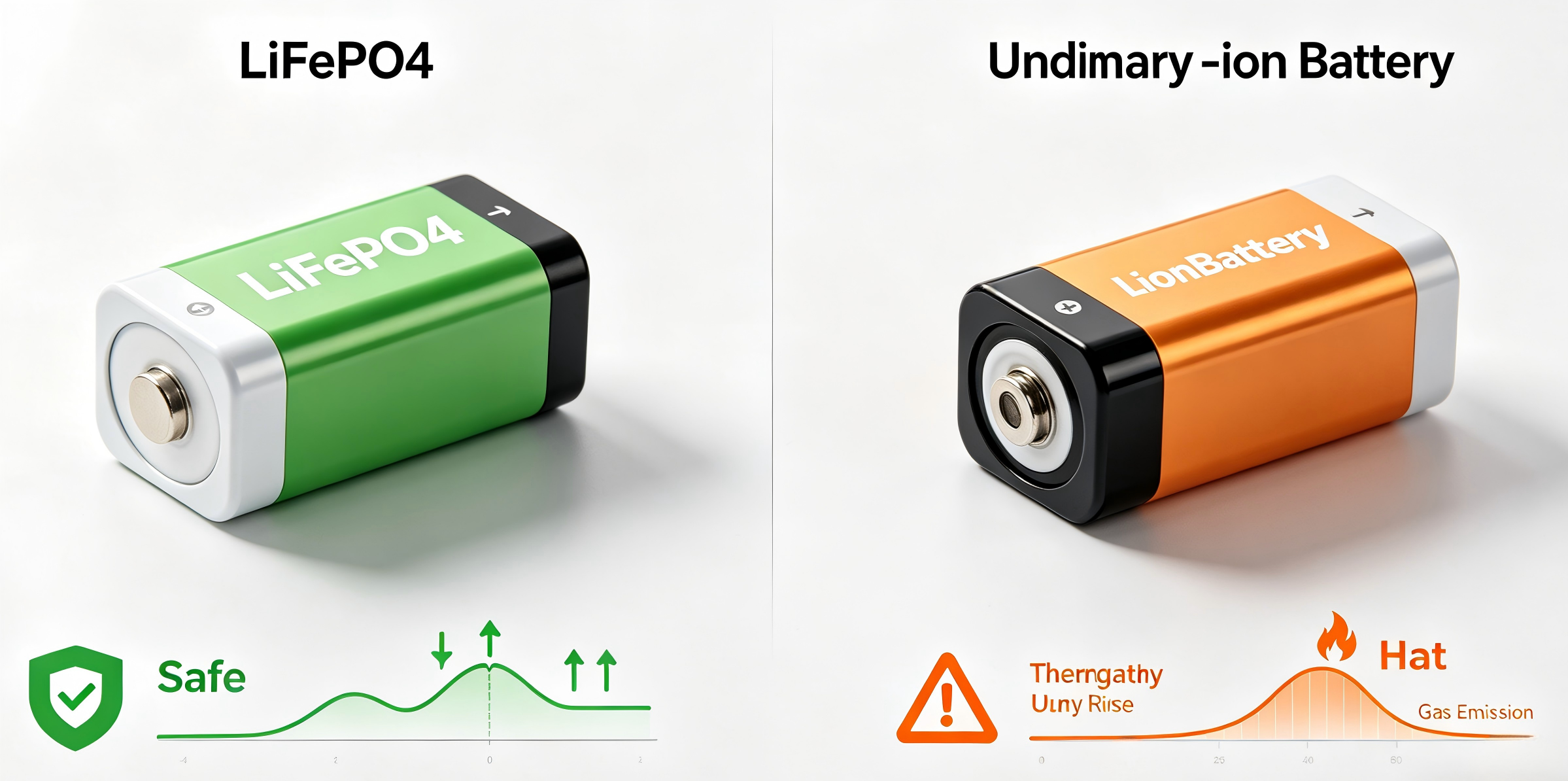
When you’re choosing a battery for home solar storage, RVs, marine systems, or off-grid power, safety isn’t just a feature—it’s the top priority.
Most people use “lithium-ion” as a general term, but not all lithium batteries are the same. Inside the lithium-ion family, LiFePO4 (Lithium Iron Phosphate) stands out as the safest, most stable chemistry available for stationary and mobile energy storage.
So you’re probably asking:
Is a LiFePO4 battery really safer than standard lithium-ion?
The short answer: YES — by design.
In this guide, we explain the real science behind LiFePO4 safety, compare it to common lithium-ion chemistries like NMC, and show why it’s become the global gold standard for reliable, risk-free energy storage.
First, let’s clarify terms to avoid confusion.
Lithium-ion is a broad category that includes many types:
LiFePO4 is a subset of lithium-ion, but with a completely different chemical structure — one built for stability, not just high energy density.
While NMC and LCO excel in phones, laptops, and high-performance EVs, LiFePO4 dominates home storage, marine, RV, industrial, and safety-critical systems.
Battery safety starts at the molecular level.
LiFePO4 uses a strong olivine crystal structure with tight covalent bonds between phosphorus and oxygen.
NMC and LCO cathodes are made with metal oxides that become unstable at high temperatures.
When overheated or damaged:
This is the single biggest reason LiFePO4 is safer.
Thermal runaway is the dangerous self-heating cycle that causes batteries to fail catastrophically.
LiFePO4 has a much higher thermal runaway threshold.
| Battery Type | Thermal Runaway Temp | Peak Temp | Oxygen Release? |
|---|---|---|---|
| LiFePO4 | 230–270°C | ~620°C | No |
| NMC Lithium-Ion | 160–210°C | ~800°C | Yes |
Lab tests prove LiFePO4’s safety advantages under real-life abuse.
LiFePO4 remains stable.
Other lithium-ion chemistries can overheat rapidly.
If safety matters to you, this is not even close.
Chemistry is the first layer of safety.
A high-quality BMS (Battery Management System) is the second.
The BMS actively prevents:
Combined with LiFePO4’s natural stability, you get double-layer safety that other batteries simply cannot match.
Top manufacturers certify LiFePO4 batteries to strict global safety standards:
These certifications confirm:
Always buy certified LiFePO4 batteries — especially for home or marine use.
LiFePO4 is the safest choice for:
If you use batteries inside a vehicle, home, or enclosed space, LiFePO4 is the most responsible choice.
Q: Can LiFePO4 batteries catch fire?
A: Extremely rarely.
Only under extreme, intentional abuse. LiFePO4 is far safer than any other lithium chemistry.
Q: Is LiFePO4 heavier than lithium-ion?
A: Yes, slightly — but for stationary, RV, marine, and home storage, weight is not a problem. Safety is far more important.
Q: How long do LiFePO4 batteries last?
A: 4000–6000+ cycles — 3–4x longer than standard lithium-ion.
Q: Is LiFePO4 better for indoor use?
A: Yes — it’s the safest lithium chemistry for indoor installation.
Absolutely YES.
LiFePO4 batteries are safer because:
If you want performance and peace of mind,
LiFePO4 is the safest lithium battery you can buy.
Looking for safe, certified, long-lasting LiFePO4 batteries for home, RV, marine, or solar storage?
We offer premium LiFePO4 batteries with full protection, strict certifications, and reliable global delivery.
✅ Full Safety Certifications ✅ BMS Protection ✅ Long Cycle Life ✅ Expert Support
Have questions about LiFePO4 battery selection? Talk to our battery experts anytime
Email: info@bak-tech.com | Tel: +86 138 2871 3564


 Hotline
 Email
Email
 Address
RM 2201, Longshenghengbo Center, Jianshe East Road and Bulong Road Intersection, Longhua District, Shenzhen, Guangdong, China
B13 Bldg, Lihe Zijing Science and Technology Innovation Center Headquarters, No. 55, Qinghu East Road, Qingxi Town, Dongguan City, Guangdong Province, P.R. China


 Previous