

May 12, 2026 |BAKTH
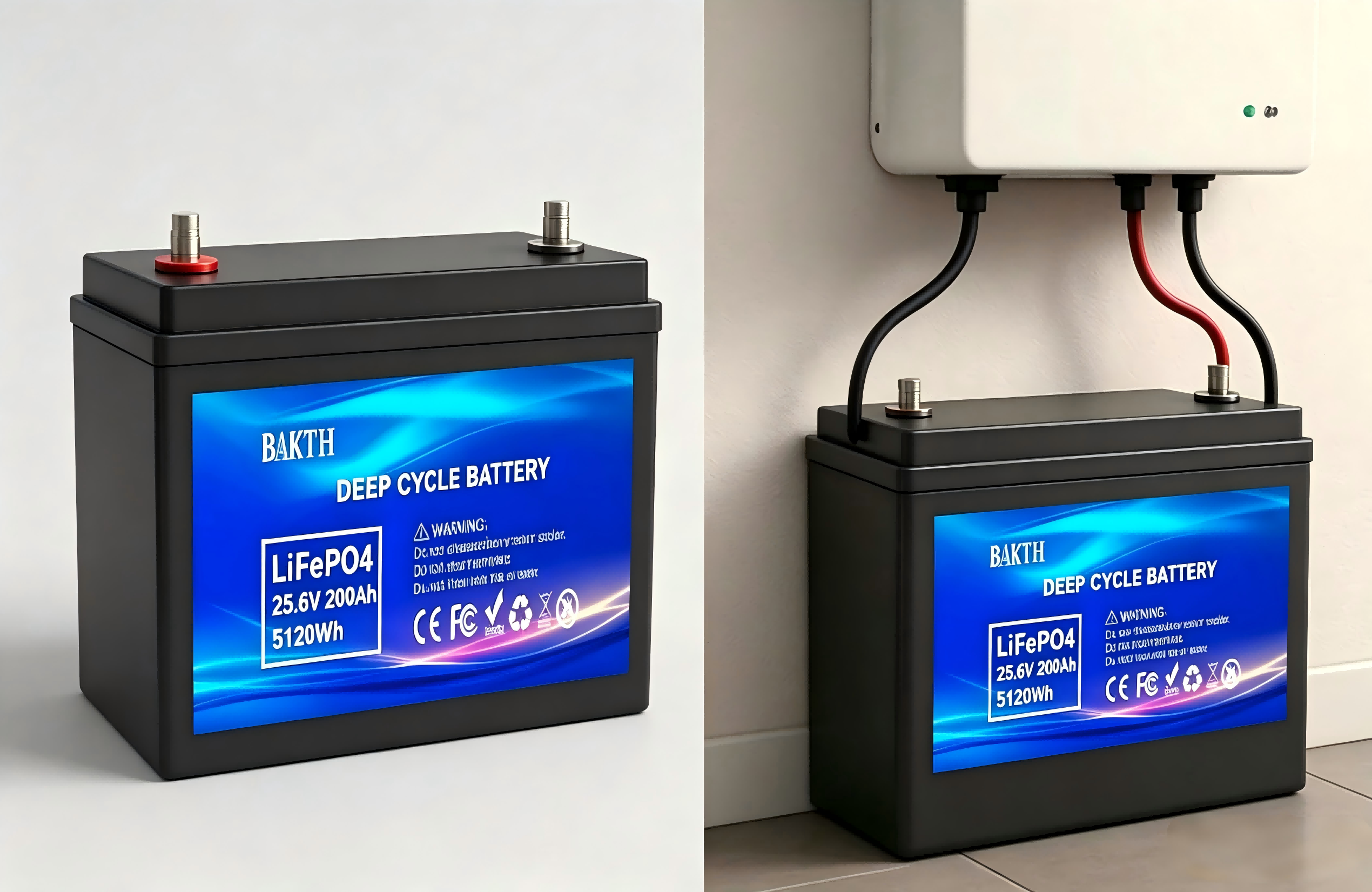
If you’re investing in a solar storage system, RV power setup, or off-grid energy solution, one question always rises to the top: How long will a LiFePO4 battery really last?
Unlike lead-acid batteries that need frequent replacement, LiFePO4 (Lithium Iron Phosphate) batteries are marketed as “10-year workhorses.” But is that true in real life? What happens after 5 years? How much capacity do they lose after a decade?
In this guide, we break down real-world LiFePO4 battery lifespan, from day one to year ten, and explain exactly what affects long-term performance.
LiFePO4’s long life isn’t luck—it’s chemistry.
Unlike NMC or lithium-cobalt batteries, LiFePO4 uses a stable olivine crystal structure with strong phosphorus-oxygen bonds. This rigid framework:
This inherent stability is why LiFePO4 outlasts all other lithium chemistries.
LiFePO4 lifespan is measured in two ways:
A full charge + discharge = one cycle.
Standard LiFePO4: 3,000–5,000 cycles
Premium Grade: 5,000–6,000+ cycles
Most LiFePO4 batteries reach 80% capacity after 3,000+ cycles—still fully usable.
Even if unused, batteries age over time.
LiFePO4: 10–15 years (slowest aging among lithium types)
How deeply you discharge the battery directly affects lifespan:
For the first 5 years, LiFePO4 batteries perform like new.
In daily solar use (day charge / night discharge), the battery shows zero visible aging during this period.
After 5 years, slow, predictable aging begins.
With these habits, 10–15 years of reliable service is standard.
| Battery Type | Cycle Life | Calendar Life | Best For |
|---|---|---|---|
| LiFePO4 | 3,000–6,000 | 10–15 yrs | Solar, RV, home storage |
| NMC Lithium | 1,000–2,000 | 5–8 yrs | EVs, high-density use |
| Lead-Acid | 300–500 | 3–5 yrs | Cheap, short-term use |
Q: Will my LiFePO4 battery die after 10 years?
A: No. It will have 70–80% capacity and still work perfectly for most applications.
Q: Can LiFePO4 last 15 years?
A: Yes with moderate use, 80% DoD, and stable temperatures.
Q: Is LiFePO4 worth the extra cost?
A: Absolutely. 10+ year life = lower total cost than lead-acid or NMC.
Q: Does BMS affect lifespan?
A: Yes. A quality BMS doubles battery life by balancing cells and preventing abuse.
As a professional lithium battery manufacturer, we produce premium LiFePO4 batteries built for 10+ years of reliable performance.
✅ Full Safety Certifications ✅ Built-In BMS ✅ Long Cycle Life ✅ Custom OEM Support
Need custom LiFePO4 battery solutions? Reach out to our battery experts
Email: info@bak-tech.com | Tel: +86 138 2871 3564


 Hotline
 Email
Email
 Address
RM 2201, Longshenghengbo Center, Jianshe East Road and Bulong Road Intersection, Longhua District, Shenzhen, Guangdong, China
B13 Bldg, Lihe Zijing Science and Technology Innovation Center Headquarters, No. 55, Qinghu East Road, Qingxi Town, Dongguan City, Guangdong Province, P.R. China


 Previous