

Jun 24, 2026 |BAKTH
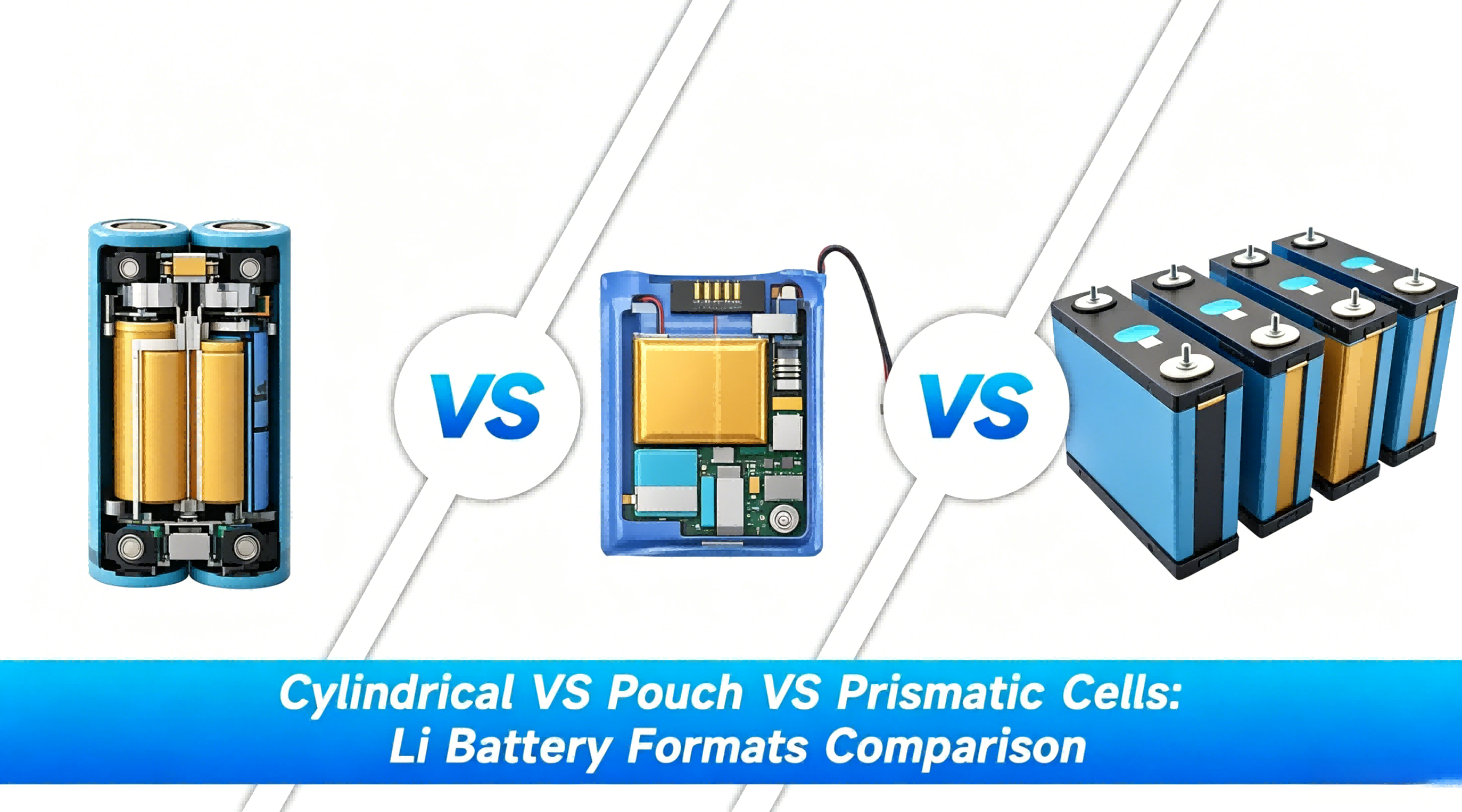
Three physical lithium cell constructions serve nearly all power applications worldwide, each with unique strengths and inherent drawbacks. No single cell type fits every project, so OEM designers and bulk buyers must match cell format to product size, safety, weight and cost demands.
Cylindrical lithium cells feature wound electrode cores sealed inside rigid metal steel or aluminum cans. Their biggest strengths are simple mass production and stable mechanical structure.
Prismatic cells adopt rectangular hard metal or plastic shells to deliver compact flat sizing. The flat layered design improves stacking space efficiency compared to cylindrical cells.
Invented in 1995, pouch cells revolutionized lithium design by replacing rigid metal casings with lightweight aluminum-plastic composite film packaging. This flexible soft structure delivers the highest packaging efficiency of all lithium cell types, reaching 90–95% space utilization inside battery packs.
Key base characteristics of pouch cells:
Widely adopted across consumer electronics, specialty portable equipment and modern new energy vehicle battery systems.
Two mainstream production methods create lithium cell electrode cores: winding and stacking. Stacking technology is the primary manufacturing process for high-performance pouch cells.
Winding rolls long continuous anode, cathode and separator sheets into a single spiral core, the standard process for cylindrical and most low-cost prismatic cells. While fast to produce, winding creates uneven stress distribution and higher internal resistance after long cycles.
Stacking cuts electrodes into small individual sheets, then layers anode, separator and cathode piece-by-piece to build a flat cell core, sealed inside aluminum plastic film pouch housing.
Measured performance improvements vs winding cells under identical material specs:
Stacked pouch cells deliver uniform chemical reaction across all electrode layers, reducing capacity attenuation during repeated charging and discharging cycles.
Pouch cell modules integrate built-in standardized BMS support, configurable for series wiring to boost voltage or parallel wiring to expand capacity. The BMS supports external communication cables for smart device monitoring. Individual modules can charge separately or as a unified complete pack, offering unmatched layout flexibility for slim, irregular product housings.
Lab accelerated cycle testing proves premium pouch cells deliver outstanding durability. A standard 10Ah pouch cell retained roughly 9Ah usable capacity after the equivalent of over 4,400 full charge cycles — only a 10% total capacity drop after approximately 12 years of regular daily use. Capacity fade after 100 cycles is 4%–7% less than aluminum-shell prismatic alternatives.
Multi-cell packs built with pouch cells drastically reduce potential fault nodes compared to cylindrical packs.
Example comparison: A 36V 10Ah battery only requires 12 pouch cells welded together (24 connection nodes). An equivalent 18650 cylindrical pack needs 72 individual 1.5Ah cells, creating 144 connection points.
Every weld joint acts as a potential failure source. If one single pouch cell malfunctions, the rest of the pack remains operational and faulty units can be replaced individually. Cylindrical series strings fail entirely when one cell degrades. Pouch cell tab welding processes also offer superior stability versus cylindrical cell assembly.
With 90–95% packaging efficiency, pouch cells fit far more energy capacity into fixed enclosure dimensions than cylindrical cells. The flexible soft film eliminates wasted empty gaps between rigid round casings, maximizing usable energy density for compact portable devices.
All lithium cells swell when internal pressure builds from side reactions, but pouch cells avoid catastrophic explosions. Cylindrical metal cans trap rising internal pressure; constrained expansion inside tight pack compartments leads to violent ruptures and fire hazards. Pouch aluminum film only inflates visibly to signal faults, without explosive force, granting staff time to isolate damaged units safely.
Pouch cells cut significant weight versus rigid-shell alternatives with matching rated capacity:
Reduced pack weight lowers shipping costs and improves runtime for wearable, drone and mobility equipment.
Automated full production lines handle cutting, stacking, sealing and formation for pouch cells, followed by strict manual sampling inspection. Full machine processing eliminates human assembly errors, ensuring consistent internal resistance, capacity and voltage across every batch of finished cells. Uniformity directly improves pack balance and extends overall service life.
All custom pouch cell packs can ship with pre-installed dedicated BMS boards out of the factory. The built-in management system delivers cell balancing, overcharge protection, over-discharge cutoff and over-current safety shutoff, eliminating extra circuit design work for OEM manufacturers of small and medium-sized devices.
While pouch cells carry numerous performance benefits, they have clear drawbacks that limit universal adoption:
Pouch cells excel for products prioritizing slim profiles, light weight, custom shapes and mild working vibration environments:
Pouch cells are not recommended for heavy industrial machinery, high-vibration construction equipment or large stationary energy storage without robust metal frame reinforcement.
Many major automotive brands including Tesla and BYD continue adopting cylindrical 18650/21700 cells for main power packs, despite pouch cell energy density advantages. The core reasons include:
Even with thousands of individual cylindrical cells in one pack, tab welding creates stable parallel-series connections, limiting performance impact if one single cell fails. Large-format prismatic cells carry higher risk because one degraded unit accounts for a much larger share of total pack capacity.
The worldwide pouch lithium battery market maintains steady upward penetration driven by demand for lightweight, slim consumer tech and new energy passenger vehicles:
For B2B buyers, equipment OEMs and battery pack assemblers, pouch cell customizability creates differentiated product lines with lighter weight, longer runtime and safer failure modes, attracting eco-conscious and portable-device end customers across North America, Europe and Australia.
Pouch lithium polymer cells stand out among all three lithium formats thanks to unmatched shape flexibility, ultra-light weight, high packaging efficiency, long cycle life and safer swelling-only failure characteristics. Stacking manufacturing technology further elevates pouch cell energy density and durability for consumer electronics, wearables and light electric vehicles.
While cylindrical cells retain cost and vibration-resistance advantages for mass automotive production, global market data confirms steady growth in pouch cell penetration across EV and portable power sectors. As aluminum plastic film supply chains mature and production costs fall, pouch cell technology will unlock broader commercial opportunities for OEMs seeking slim, high-performance, differentiated battery-powered products.
If you require custom-sized stacking pouch cell samples, tailored BMS integration or bulk wholesale battery solutions, reach out to our engineering team for detailed technical specifications and quotation support.
BAKTH produces high-uniformity stacked pouch cells with fully customizable dimensions, integrated BMS and lightweight soft packs for wearables, 3C devices, light EVs and portable industrial equipment bulk OEM orders.
BAKTH Battery Engineering Team | Custom Pouch & Cylindrical Lithium Cell Manufacturer
Stacked Lithium Polymer Pouch Cells For 3C, Wearables, Drones & Light EV OEM Projects


 Hotline
 Email
Email
 Address
RM 2201, Longshenghengbo Center, Jianshe East Road and Bulong Road Intersection, Longhua District, Shenzhen, Guangdong, China
B13 Bldg, Lihe Zijing Science and Technology Innovation Center Headquarters, No. 55, Qinghu East Road, Qingxi Town, Dongguan City, Guangdong Province, P.R. China


 Previous