Introduction
Self-discharge is the natural internal chemical reaction that drains battery power even when no device is connected. High self-discharge shortens shelf life, ruins seasonal equipment, causes unbalanced multi-cell packs, and accelerates permanent capacity fade. While self-discharge cannot be fully eliminated, there are actionable, industry-verified steps to drastically slow its rate for all battery types, from consumer electronics to industrial backup power and remote sensor cells.
1. Control Storage Temperature (The #1 Most Effective Method)
Temperature is the biggest factor accelerating self-discharge across every battery chemistry. Every 10°C rise above room temperature roughly doubles the speed of internal chemical side reactions.
Universal Storage Temperature Rule
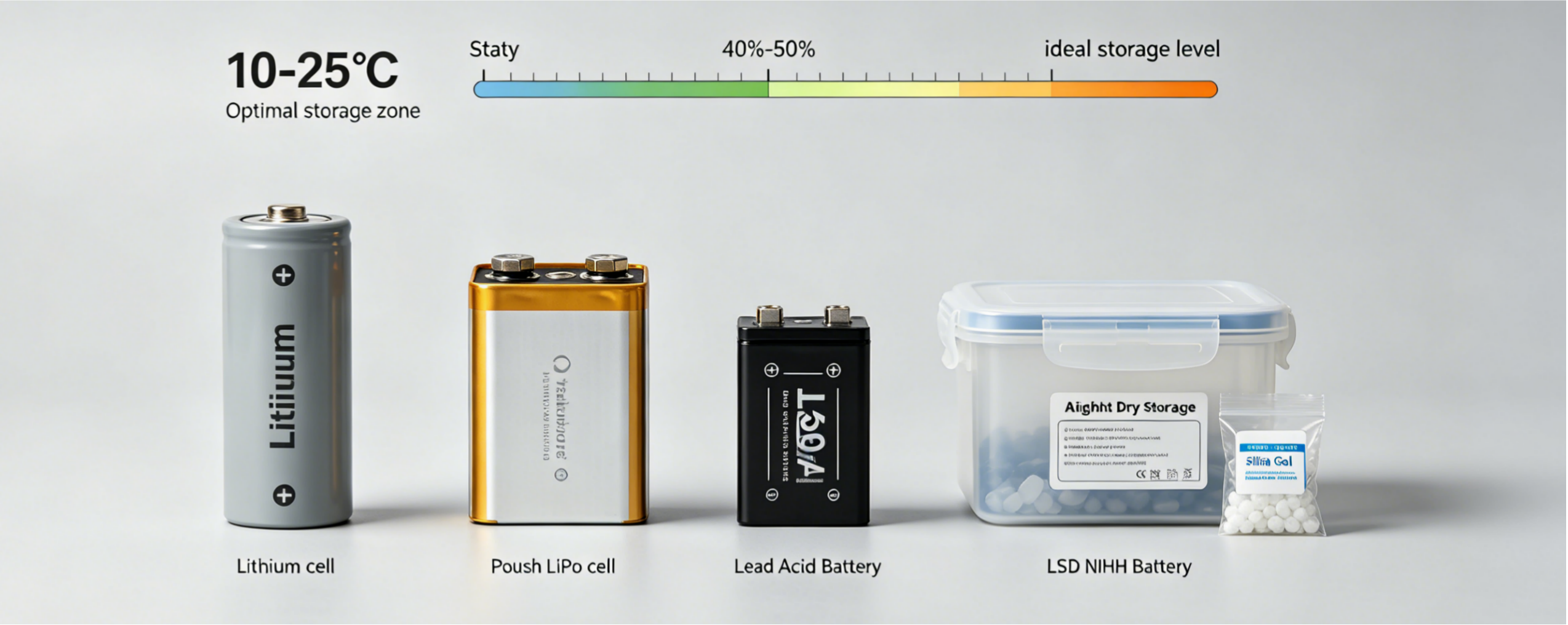
- Optimal long-term storage range: 10°C – 25°C (50°F – 77°F)
- Never store batteries above 35°C / 95°F (garages, car trunks, sun-exposed sheds)
- Avoid freezing temperatures below 0°C for rechargeable lithium and lead-acid cells (cold cracks separators and damages electrodes)
Practical Habits
- Move seasonal batteries indoors during summer heat and winter frost.
- Use insulated storage cabinets for industrial battery inventory in hot workshop environments.
- Do not charge batteries while they are hot from heavy use; let them cool fully before storage.
2. Store Batteries at the Optimal State of Charge (SoC)
Storing cells fully charged (100%) or fully drained (0%) triggers severe internal degradation and speeds self-discharge dramatically. Each chemistry has a recommended mid-range charge level to minimize idle reaction:
| Battery Type | Ideal Storage SoC | Reason |
|---|
| Lithium-Ion / LiPo Pouch | 40% – 50% | Eliminates high voltage stress that breaks down SEI layers and electrolyte |
| Lead-Acid (AGM / Gel / Flooded) | 70% – 80% | Prevents plate sulfation, the main driver of lead-acid self-discharge |
| Standard NiMH / LSD NiMH | 30% – 50% | Reduces thin insulator leakage inside NiMH cells |
| Primary Lithium (LiSOCl₂ / Alkaline) | Full factory charge | Primary cells are designed for long shelf life at full capacity |
Tip: For lithium packs left unused over 2–3 months, top up back to 40–50% charge every 90 days to avoid deep discharge from accumulated self-discharge.
3. Maintain a Dry, Humidity-Controlled Storage Environment
Excess moisture penetrates battery casings and creates internal contamination that amplifies self-discharge:
- Humidity above 60% accelerates electrolyte decomposition in lithium cells.
- Moisture triggers corrosion on lead-acid terminal plates and internal metal impurities.
- Soft pouch LiPo cells have thinner aluminum-laminate barriers and are far more sensitive to humid air than rigid cylindrical cells.
Solutions
- Store batteries in airtight plastic bins with silica gel desiccant packs.
- Avoid damp basements, outdoor storage sheds and coastal high-humidity locations.
- Seal loose pouch cells in moisture-proof packaging for long idle periods.
4. Select Low Self-Discharge Battery Chemistries Upfront
If you regularly store batteries for months at a time, choose cell chemistries engineered for minimal idle capacity loss from the start:
- Ultra-low self-discharge for multi-year standby: Bobbin Lithium Thionyl Chloride (LiSOCl₂) primary cells (<1% capacity loss per year, up to 40-year shelf life)
- Rechargeable low-self-discharge pick: LSD Low Self-Discharge NiMH (only 0.25% loss monthly)
- Balanced rechargeable lithium: Hard-shell cylindrical/prismatic lithium-ion (2–3% monthly loss), better than LiPo pouch (~5% monthly self-discharge)
- Avoid high self-discharge options: Standard high-capacity NiMH (30% monthly), NiCd (15–20% monthly), cheap flooded lead-acid (up to 8% monthly)
5. Avoid Physical Damage & Internal Cell Contamination
Drops, punctures, vibration and overcharging create internal defects that permanently raise self-discharge rates:
- Overcharging creates microcracks in separator films, forming tiny internal leakage paths inside lithium cells. Always use BMS-protected chargers to cut off power at full voltage.
- Shocks and vibration misalign electrode layers, introducing metal particle impurities into the electrolyte that trigger continuous side reactions.
- Punctured pouch cells lose their moisture barrier, instantly accelerating electrolyte breakdown and self-discharge.
Prevention
- Use padded carrying cases for portable lithium and NiMH battery packs.
- Never overcharge any lithium or lead-acid cell.
- Inspect cells for swelling, dents or damaged sealing before long-term storage; discard damaged units.
6. Optimize Lithium-Ion Pack Manufacturing Materials
For OEMs, pack assemblers and factory production lines, standard PET electrode tape is a hidden cause of elevated self-discharge:
PET tape decomposes under warm storage temperatures and releases redox shuttle molecules that continuously cycle between cathode and anode, draining charge nonstop while idle.
Fix: Replace conventional PET binding tape with chemically inert alternative adhesive tapes during cell stacking assembly. This eliminates shuttle compound formation and noticeably cuts long-term self-discharge, especially for packs destined for high-temperature working environments.
7. Separate Batteries from Parasitic Standby Loads
Parasitic drain (constant small power draw from device clocks, sensors, monitoring boards) is often mistaken for self-discharge. To measure true internal self-discharge:
- Fully disconnect batteries from all external circuits before storage.
- Remove battery connectors from equipment if the gear will sit unused for over 30 days.
- For EVs, RVs and UPS systems with permanent housekeeping loads, install master disconnect switches to isolate battery banks during seasonal storage.
8. Chemistry-Specific Extra Tips for Lower Self-Discharge
Lithium-Ion & LiPo
- Use high-quality cells with pure electrolyte and reinforced separators to slow SEI degradation.
- Avoid fast charging before long storage; slow standard charging creates less internal stress.
Lead-Acid
- Choose AGM or Gel sealed lead-acid over low-cost flooded variants to cut monthly self-discharge from 8% down to 4%.
- Perform periodic equalization charging for stationary lead-acid battery banks to reduce plate sulfation.
NiMH
Prioritize LSD low-self-discharge NiMH over high-capacity standard NiMH for long-shelf applications like remote sensors.
Primary Lithium LiSOCl₂
Select premium bobbin construction cells instead of spiral-wound versions for minimal annual self-discharge.
9. FAQ
Q1: Can I completely stop battery self-discharge?
A: No. Self-discharge comes from unavoidable internal chemical reactions in all sealed cells, but you can slow its rate by 50% or more with proper storage and material choices.
Q2: Why do LiPo pouch batteries self-discharge faster than cylindrical lithium cells?
A: Thin aluminum-plastic laminate packaging offers weaker protection against oxygen and moisture penetration, speeding electrolyte breakdown and monthly capacity loss.
Q3: How much does heat affect self-discharge speed?
A: Every 10°C temperature increase roughly doubles the self-discharge rate of all battery chemistries. Hot storage is the fastest way to drain idle batteries prematurely.
Q4: Does PET tape really increase lithium-ion self-discharge?
A: Academic battery research confirms PET tape decomposes at elevated temperatures to create redox shuttle molecules that drain stored energy continuously during storage; inert tape alternatives resolve this issue.
Q5: What battery has the slowest self-discharge for long-term storage?
A: Bobbin-style lithium thionyl chloride primary cells, with less than 1% capacity lost per year and a usable shelf life up to 40 years.
Q6: Should I store lithium batteries fully charged or empty?
A: Neither. The ideal state of charge for long lithium storage is 40%–50% to minimize high-voltage chemical stress and slow SEI layer overgrowth.




 Hotline
 Email
Email
 Address


 Previous