

Aug 24, 2026 |BAKTH
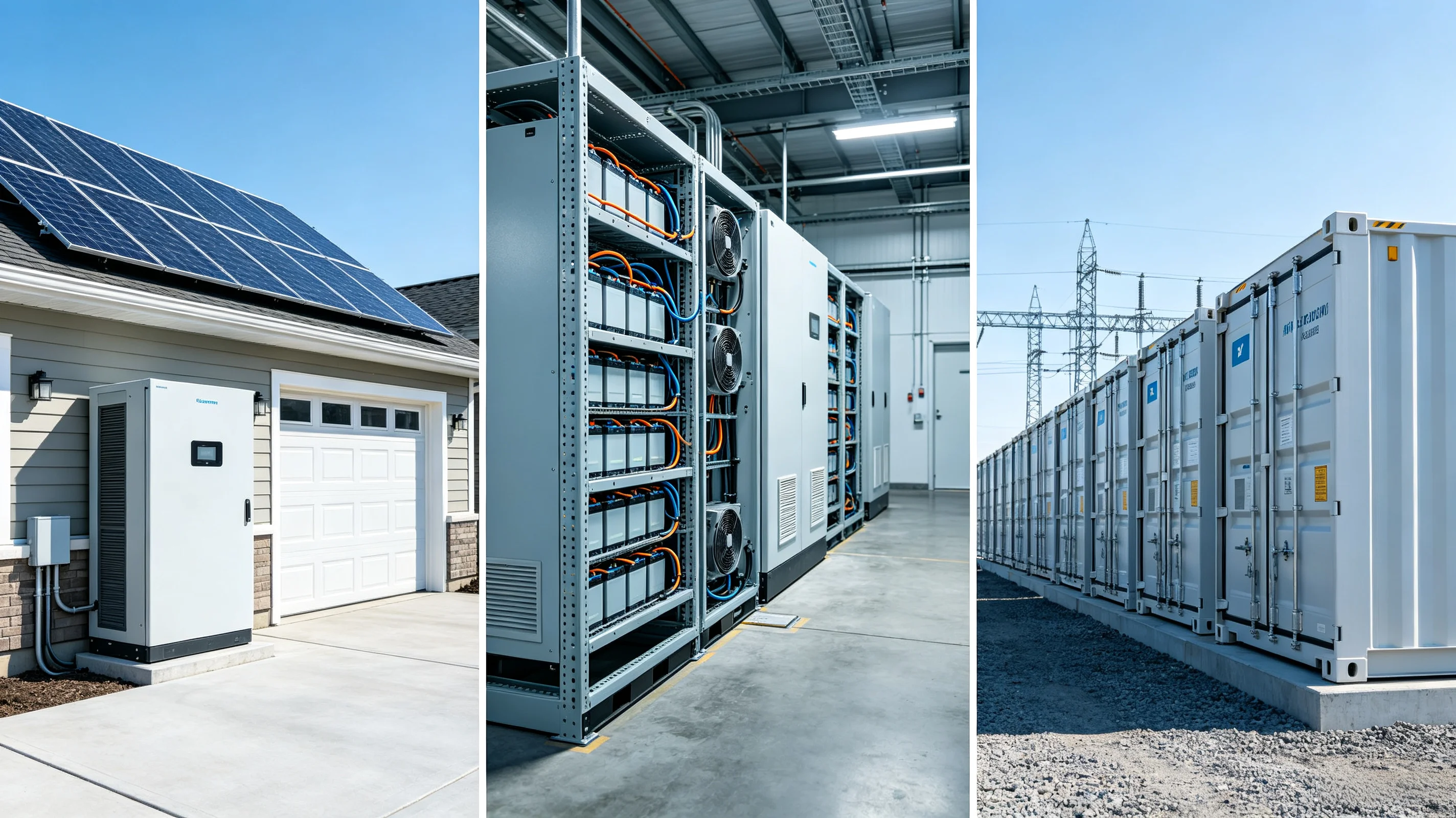
Choosing battery storage purely by advertised kWh often leads to under‑delivered backup, wasted budget, or disappointing solar self‑consumption results. This practical sizing guide walks you through real‑world calculations across homes, businesses, solar‑storage hybrids and grid‑connected deployments, so you match battery performance to actual site requirements.
Battery sizing starts with understanding your site energy profile before comparing hardware options. Many buyers jump straight to product spec sheets and overlook how operating constraints cut real‑world output from headline ratings.
Manufacturers publish rated (nameplate) capacity as total theoretical energy stored inside battery cells. What you can actually draw for your loads is usable capacity, reduced by built‑in safety rules: depth‑of‑discharge (DoD) limits, reserved emergency energy, and round‑trip energy losses during charge‑discharge cycles.
A 10 kWh rated battery does not automatically deliver 10 kWh for your equipment. If BMS software locks 10 % capacity for protection, only 9 kWh becomes accessible for daily operation. Always build your calculations around usable capacity instead of marketing‑friendly nameplate figures.
Key variables you must evaluate:
Total daily kWh consumption alone cannot drive accurate sizing. Two sites consuming identical 30 kWh per day can need completely different battery banks: one may feature sharp evening demand spikes, while the other runs steady flat loads all day long.
Gather interval meter readings, separate critical must‑run loads from non‑essential devices, and note seasonal usage swings.
Essential metrics for sizing:
Common error: Ordering batteries from catalog specifications without reviewing load curves. This results in either insufficient backup autonomy or oversized systems that rarely cycle to full capacity.
Do not confuse energy capacity with power rating.
A battery with large kWh energy storage can still fail project requirements if inverter output power cannot handle site peak loads. Depth‑of‑discharge, round‑trip efficiency and target autonomy all feed into your final calculation.
Practical sizing formula:
Required rated battery capacity = Target usable load energy ÷ (usable discharge fraction × system round‑trip efficiency)
Modern energy storage systems solve multiple objectives at once. Residential installations balance bill savings and blackout resilience. Commercial deployments focus on demand charge reduction plus business continuity. Utility‑scale fleets deliver grid stabilization services via virtual power plant aggregations. As energy‑storage market growth accelerates across North America and Europe, rough guesswork no longer delivers solid project ROI.
Skip picking generic 5 kWh, 10 kWh or 15 kWh battery tiers. Start by defining exactly which appliances need power and your target backup hours.
Small‑scale setups supporting fridges, lighting, Wi‑Fi and basic small appliances require modest usable capacity. Homes pursuing heavy evening solar self‑consumption, heat pump operation or partial whole‑house backup demand significantly larger storage.
Residential sizing checklist:
Guidelines for residential use‑cases:
Modular residential ESS platforms allow capacity expansion later, matching real‑world consumption growth instead of over‑investing upfront.
For commercial sites, short‑interval 15‑minute meter data outweighs total daily consumption numbers. Facilities with moderate overall energy use can incur massive penalty fees triggered by brief, high‑power demand spikes.
Two separate parameters demand correct sizing:
Commercial sizing checklist:
Frequent commercial mistake: over‑size battery energy (kWh) while under‑sizing discharge power (kW). The outcome is a physically large storage system incapable of mitigating real‑world demand spikes.
Modular LFP commercial storage supports phased capacity scaling. Rack‑mount battery units enable incremental expansion without full system replacement, ideal for growing manufacturing and retail sites.
For PV‑battery hybrid systems, size storage around the energy gap between solar generation and on‑site consumption. Solar panels produce surplus power during midday, while most household and business load occurs after sunset; batteries bridge this mismatch.
Solar‑storage checklist:
High‑return scenarios: large midday solar surplus paired with stable evening loads makes load‑shifting economically attractive. Where PV surplus remains limited yet night‑time consumption stays high, run thorough feasibility reviews before large‑scale battery investment.
Modern hybrid inverters support generous PV oversizing, fast UPS‑mode transfer during grid faults and cloud‑based remote tuning. Modular battery architecture lets you add storage capacity post‑commissioning guided by real measured solar yield data.
EV chargers introduce concentrated, high‑power draws that reshape building load profiles dramatically, especially during evening peak‑tariff windows. Sizing must account for charging‑session runtime plus simultaneous operation of other building equipment.
Key considerations:
Checklist for mixed‑use locations:
For mixed‑load sites, batteries rarely need to run every charger at maximum power continuously. Optimised strategy: preserve power for critical essential loads, dynamically reduce EV‑charging output during demand peaks. Intelligent energy management frequently delivers better results than simply purchasing larger‑kWh batteries. Sizing and control logic must be designed hand‑in‑hand.
At fleet and virtual‑power‑plant scale, sizing logic differs substantially from standalone site backup systems. Dispatch rules, aggregator requirements, reserve obligations and communication protocols define reliable committed capacity. Even large aggregated fleets suffer poor dispatch performance when individual sites are sized too tightly for local load conditions.
VPP project checklist:
VPP‑ready hardware supports standard grid‑communication protocols alongside micro‑grid operating modes. Utility projects require not only adequate kWh capacity, but robust orchestration, remote monitoring and expandability to balance grid‑service obligations and on‑site user reliability.
Follow this proven sequence for consistent, defensible sizing for any project type:
Step 1: Establish baseline consumption and critical operating windows
Collect daily energy‑use data. Measure energy consumed during the exact time batteries must supply power (overnight blackouts, multi‑hour peak‑demand windows). Separate essential versus non‑essential loads and account for seasonal demand shifts.
Important: Avoid sizing purely on full‑day total consumption values. Backup may only require overnight support; peak‑shaving may target short 1‑2 hour spikes.
Step 2: Translate operational needs into usable‑capacity requirements
Treat usable capacity as your primary calculation metric. Rated nameplate capacity serves only as your starting reference. Factor round‑trip efficiency losses before final hardware selection.
Required rated battery capacity = Target load energy ÷ (usable discharge fraction × system efficiency)
Step 3: Build headroom for future growth
For stable static loads, tighter sizing works fine. Where consumption will rise, select modular expandable storage systems to retain upgrade headroom. For sites facing unknown future electrification, pick stackable, parallel‑capable battery platforms.
✅ Best Practices
❌ Critical Pitfalls to Avoid
Accurate battery‑capacity sizing revolves around real‑site load requirements instead of marketing‑driven product tiers. Stick to this workflow: collect measured consumption data → define your exact support time‑window → calculate usable‑energy demand → apply system‑efficiency corrections → add safety margin for future growth. This methodology applies equally to residential homes, commercial buildings, solar‑storage hybrids, EV‑heavy locations and utility‑scale VPP fleets.
When evaluating storage hardware, favour modular expandable systems paired with cloud‑based monitoring, to support staged scaling as project needs evolve.
Q: How should I calculate battery size based on daily usage?
Start from energy consumed in the exact time window batteries must cover. Divide target load energy by usable discharge fraction multiplied by system efficiency to get required rated capacity. Add safety buffer if future‑load growth is expected. Always prioritise usable capacity over sticker‑sheet nameplate kWh values.
Q: Which battery capacity suits homes with heavy evening‑time consumption?
It depends on power demand once solar panels stop generating output. Two homes with identical total daily kWh may need very different storage sizes if one consumes most power after sunset. Base sizing on evening‑time load curves rather than 24‑hour utility‑bill totals. If emergency backup is required, add extra capacity beyond pure load‑shifting needs.
Q: How do I size energy‑storage systems for peak‑shaving applications?
Use high‑resolution interval meter data to measure both peak magnitude and peak duration. Battery energy capacity determines how long you sustain peak‑shaving discharge; power rating determines how large a demand spike you can eliminate. A battery with large kWh but low kW discharge power cannot suppress short, high‑amplitude demand peaks. Always review local tariff rules, peak‑repeat frequency and battery recovery time between events.
Q: What sizing rules apply for industrial energy‑storage deployments?
Separate production‑critical loads and non‑essential discretionary loads. Evaluate both energy (kWh) and peak‑power (kW), as factories regularly feature large transient power surges. Define reserve‑energy strategy if outage backup forms part of project scope. Modular expandable architectures deliver value as process upgrades and electrification shift site demand after installation.
Q: What real‑world difference exists between 5 kWh, 10 kWh and 15 kWh battery tiers?
Differences show up in backup autonomy, load‑handling flexibility and future‑growth headroom.
Final real‑world performance depends on usable capacity, not tier labels. Inverter power rating carries equal importance; ample stored energy cannot handle simultaneous high‑power surges with insufficient inverter output.
Q: Beyond capacity, which other parameters should buyers verify?
Inverter‑battery compatibility, maximum continuous discharge‑power, hardware expansion options, maximum safe depth‑of‑discharge, round‑trip system efficiency, safety certifications and remote monitoring capabilities. Two batteries sharing identical rated‑kWh can deliver vastly different field performance because of gaps in usable‑capacity or surge‑power handling. Quality monitoring software lets operators tune system behaviour post‑commissioning without hardware changes.
Q: Why does usable capacity usually matter more than rated capacity?
Rated capacity represents gross theoretical total stored energy. Real‑world operation applies DoD constraints, BMS‑enforced reserve‑energy locks for battery protection plus charge‑discharge conversion losses. Usable‑capacity reflects energy you can reliably rely‑on for site loads. This gap can cut expected backup runtime significantly, so usable capacity forms the correct baseline for autonomy calculations.
Q: Can batteries be over‑sized, and when does over‑sizing make sense?
Yes, over‑sizing can represent valid design choice. Over‑size storage when major future‑load growth is coming, new electrified equipment will be added, or maximum outage resilience carries high priority. It also works for sites planning phased solar‑PV expansion, where storage hardware is deployed ahead of additional solar panels. Unmotivated over‑sizing creates idle unused capacity and hurts project economics. Extra capacity should always align with foreseeable charging opportunities or confirmed load increases.


 Hotline
 Email
Email
 Address
RM 2201, Longshenghengbo Center, Jianshe East Road and Bulong Road Intersection, Longhua District, Shenzhen, Guangdong, China
B13 Bldg, Lihe Zijing Science and Technology Innovation Center Headquarters, No. 55, Qinghu East Road, Qingxi Town, Dongguan City, Guangdong Province, P.R. China


 Previous