

Oct 08, 2026 |BAKTH

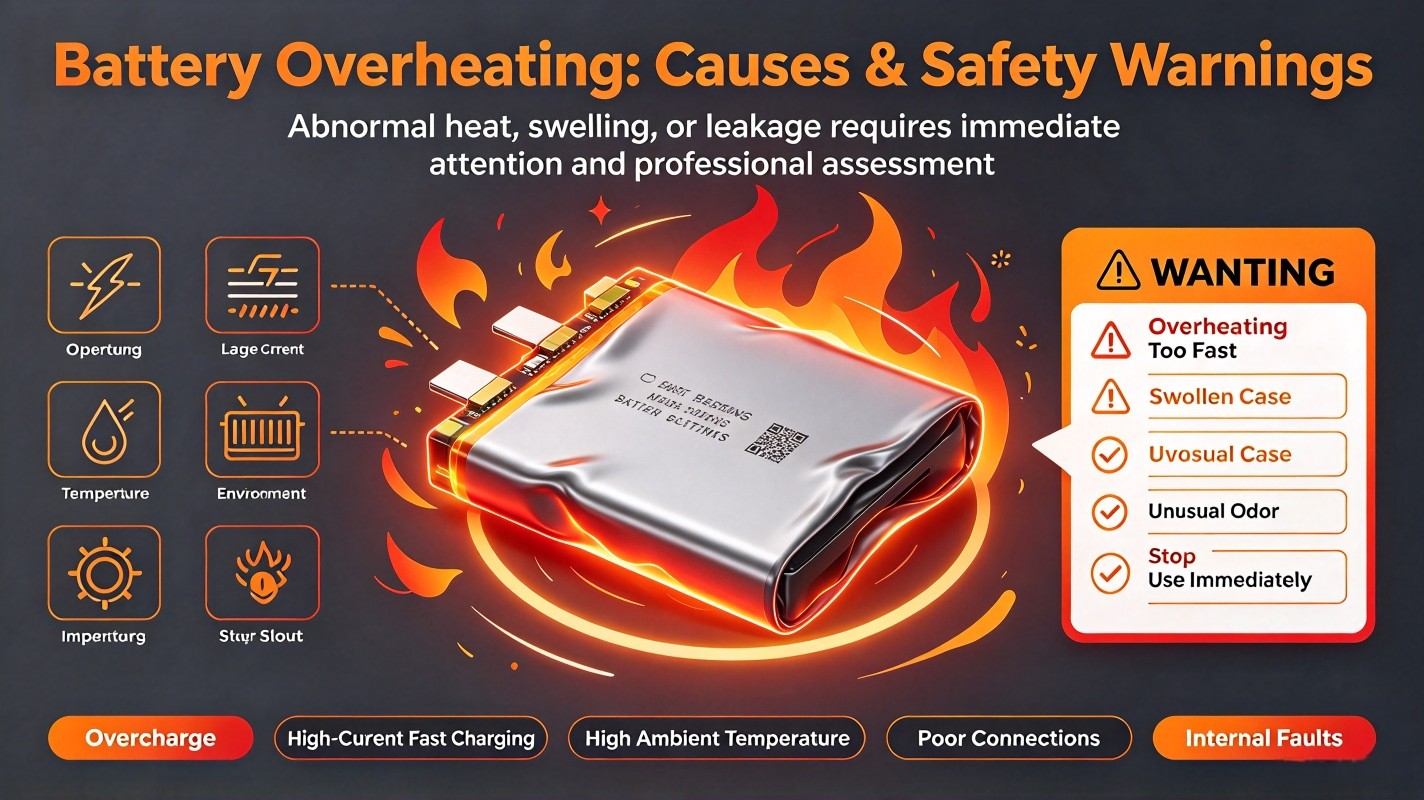
Battery overheating is an important safety concern across consumer electronics, power tools, electric vehicles, and stationary energy storage systems.
Some warmth during charging or high-load operation is normal. However, unusual or rapidly increasing heat can indicate an underlying problem that may accelerate battery degradation or, in severe cases, create a safety hazard.
This guide explains the main causes of battery overheating, the warning signs buyers and users should watch for, what to do when a battery becomes excessively hot, and how to reduce overheating risks through proper battery selection, operation, and maintenance.
Rechargeable batteries naturally generate some heat during charging and discharging. Because energy conversion is not 100% efficient, part of the electrical energy is converted into heat through internal resistance.
Fast charging and high-current discharge can increase this heat generation.
The important factor is not simply whether a battery feels warm, but whether the temperature is higher than expected for the operating conditions or continues to rise abnormally.
A battery that becomes excessively hot, heats up unusually quickly, develops swelling or deformation, or triggers repeated thermal protection should be taken out of normal operation and investigated.
The exact safe temperature range depends on the battery chemistry, cell design, BMS settings, charger, application, and manufacturer's specifications.
Overcharging can occur when a battery is charged beyond its specified voltage limits.
Possible causes include:
Excessive charging voltage can accelerate unwanted chemical reactions inside lithium-ion cells, increasing heat generation and potentially causing permanent cell damage.
For this reason, the charger and BMS should always be properly matched to the battery chemistry and voltage configuration.
Fast charging uses higher charging currents to reduce charging time.
Higher current naturally increases heat generation, although a properly designed battery pack can be engineered to handle the specified charging rate.
Problems may occur when fast charging is combined with:
For battery buyers, the maximum continuous and peak charging current should be verified before selecting a battery pack.
Power tools, e-bikes, electric vehicles, industrial equipment, and high-power inverters can draw substantial current from a battery.
Higher discharge current produces more heat because of the battery's internal resistance.
Continuous operation near or above the rated discharge current can cause excessive thermal buildup, particularly when the battery is:
The battery's continuous and peak discharge ratings should therefore match the actual load profile of the equipment.
A battery operating in a hot environment starts with a higher baseline temperature.
Direct sunlight, enclosed battery compartments, hot vehicle cabins, and insufficient airflow can make heat dissipation more difficult.
When heat cannot escape efficiently, battery temperature can continue to rise during charging or high-load operation.
This is especially important for batteries installed inside:
Proper ventilation and thermal management should be considered during system design.
Internal short circuits are among the more serious causes of battery overheating.
They can result from:
An internal short circuit can create localized heat inside a cell. In severe cases, this may trigger thermal runaway.
Because an internal short circuit may not be visible from the outside, abnormal heating, swelling, or unexpected electrical behavior should be treated seriously.
As rechargeable batteries age, their internal resistance can increase.
Higher resistance produces more heat during the same charging or discharging conditions.
An aging battery may therefore:
Heat can also accelerate battery aging, creating a cycle in which degradation and heat generation reinforce each other.
Not all battery overheating originates inside the cells.
Loose terminals, corroded connectors, poor crimps, damaged cables, and undersized wiring can create excessive contact resistance.
This resistance produces localized hot spots at:
A connection that becomes significantly hotter than the surrounding battery components should be inspected promptly.
| Effect | What It Can Cause |
|---|---|
| Accelerated aging | Faster capacity loss and shorter service life |
| Charging protection | Slower charging or automatic charging interruption |
| Discharge protection | Reduced output or unexpected shutdown |
| Cell swelling | Gas generation and permanent cell damage |
| Electrolyte venting | Odor, vapor, leakage, or pressure release |
| Thermal runaway | Rapid self-heating, smoke, fire, or cell-to-cell propagation in severe cases |
The actual outcome depends on the battery chemistry, severity and duration of overheating, cell condition, and the effectiveness of the battery's protection system.
Heat is one of the major factors that accelerates battery aging.
Repeated exposure to elevated temperatures can accelerate unwanted chemical reactions inside lithium-ion cells, resulting in:
A battery does not necessarily fail immediately after a single high-temperature event. However, repeated thermal stress can significantly affect long-term performance.
Modern battery systems often include thermal protection.
When the battery or surrounding system becomes too hot, the BMS or device controller may:
These protective actions are designed to reduce further stress on the battery.
Repeated thermal protection events, however, should not simply be ignored. They may indicate inadequate cooling, excessive load, battery aging, or another underlying problem.
Excessive heat can accelerate side reactions inside lithium-ion cells and contribute to gas generation.
Pouch cells are particularly noticeable when gas accumulation causes the flexible enclosure to expand.
A swollen or visibly deformed battery should not be squeezed, punctured, opened, or recharged.
Remove it from normal service and arrange an appropriate professional assessment or recycling process.
Severe battery damage or overheating can result in pressure release or electrolyte leakage.
Warning signs may include:
If these symptoms occur, avoid direct contact with the battery and follow the manufacturer's emergency handling procedures.
For lithium-ion batteries, severe overheating or internal damage can, under certain conditions, trigger thermal runaway.
Thermal runaway is a self-accelerating reaction in which increasing temperature can cause further heat generation inside the cell.
In a severe battery failure, this can result in:
Not every overheating event leads to thermal runaway, but batteries showing severe overheating, swelling, smoke, or other signs of damage should be treated as potentially hazardous.
Watch for the following symptoms:
One abnormal symptom does not necessarily identify the exact cause. However, several symptoms occurring together require immediate attention.
Lithium-ion batteries offer high energy density and are widely used in consumer electronics, power tools, e-bikes, electric vehicles, and energy storage systems.
LiFePO4 (LFP) generally offers better thermal stability than many NMC lithium-ion chemistries.
However, neither chemistry is immune to overheating. Overcharging, short circuits, excessive current, physical damage, and extreme temperatures can still create safety risks.
The actual thermal performance depends on the cell design, battery configuration, BMS, thermal management system, and operating conditions.
Lead-acid batteries can also overheat.
Common causes include:
Flooded lead-acid batteries may lose electrolyte through excessive gassing and evaporation under severe charging or temperature conditions.
AGM batteries are sealed designs with different venting characteristics, but they can still suffer internal damage and reduced service life when exposed to sustained high temperatures.
If a battery becomes unusually hot, stop charging or discharging it when it is safe to do so.
Do not continue using a battery that is rapidly increasing in temperature or showing signs of physical damage.
If there is no smoke, leakage, severe heat, or other immediate hazard, disconnect the charger or load according to the manufacturer's instructions.
Do not touch extremely hot components with bare hands.
For high-voltage or large industrial battery systems, follow the site's emergency procedures and have qualified personnel handle isolation.
If it is safe to do so, keep the affected battery away from paper, fabric, wood, chemicals, and other combustible materials.
Do not move a severely damaged or actively venting battery unless doing so is necessary for immediate safety.
Allow the battery to cool naturally in a safe and appropriately ventilated location.
Do not pour water onto a damaged battery or use ice, compressed cooling, or other methods that may create thermal shock or electrical hazards.
For a battery that is smoking, venting, or showing signs of fire, prioritize evacuation and follow local emergency procedures rather than attempting to cool or handle it yourself.
Watch for:
If a battery begins smoking, catches fire, or shows signs of thermal runaway, move away from the area and contact emergency services according to local procedures.
A severely overheated, swollen, leaking, punctured, crushed, or otherwise damaged battery should not automatically be returned to service.
Have it assessed by qualified battery professionals or arrange appropriate recycling according to local regulations.
For B2B battery buyers, these requirements should be considered during cell selection, BMS configuration, pack design, thermal management, and sample testing, rather than only after the battery reaches the end user.
Q: Is slight warmth while charging normal?
Yes. Some heat generation is normal during charging and discharging because of electrical resistance and energy conversion losses. However, a battery that becomes significantly hotter than expected, heats up rapidly, or repeatedly triggers thermal protection should be inspected.
Q: Can a battery be reused after overheating?
It depends on the severity and cause of the overheating. A battery that experienced mild, temporary warmth without any abnormal symptoms may not necessarily be damaged. However, a battery that experienced severe overheating, swelling, smoke, electrolyte leakage, physical damage, or repeated thermal protection should not be returned to service without an appropriate professional assessment.
Q: Which battery type is least likely to overheat?
LiFePO4 batteries generally have better thermal stability than many NMC lithium-ion batteries. However, chemistry alone does not determine overheating risk. Cell quality, BMS protection, charging conditions, thermal management, pack design, and operating environment all matter.
Q: Can bad wiring cause battery overheating?
Yes. Loose, corroded, damaged, or undersized wiring can increase electrical resistance and create localized hot spots. If a connector, cable, or terminal becomes significantly hotter than the rest of the battery system, the connection should be inspected before continued operation.
Q: How should I dispose of an overheated battery?
Do not place a damaged or severely overheated lithium battery in household garbage or standard recycling bins. Keep it isolated from normal battery inventory where safe to do so, avoid further charging or use, and contact an appropriate battery recycling or hazardous-material handling service in accordance with local regulations. Do not attempt to open, puncture, or dismantle the battery yourself.
Battery overheating is often a sign that operating conditions, battery design, or a component within the system needs attention.
Common causes include excessive charging or discharge current, high ambient temperatures, poor ventilation, aging cells, damaged connections, and internal cell faults.
Recognizing early warning signs can help buyers and users respond before a minor thermal issue develops into serious battery damage.
For lithium battery packs, effective BMS protection, appropriate thermal management, correct charger selection, reliable cell quality, and proper pack design are all important parts of a safe and reliable battery system.
If a battery becomes severely hot, swollen, damaged, smoky, or leaky, stop using it and follow appropriate professional handling and recycling procedures.


 Hotline
 Email
 Address
RM 2201, Longshenghengbo Center, Jianshe East Road and Bulong Road Intersection, Longhua District, Shenzhen, Guangdong, China
B13 Bldg, Lihe Zijing Science and Technology Innovation Center Headquarters, No. 55, Qinghu East Road, Qingxi Town, Dongguan City, Guangdong Province, P.R. China


 Previous