

Oct 12, 2026 |BAKTH
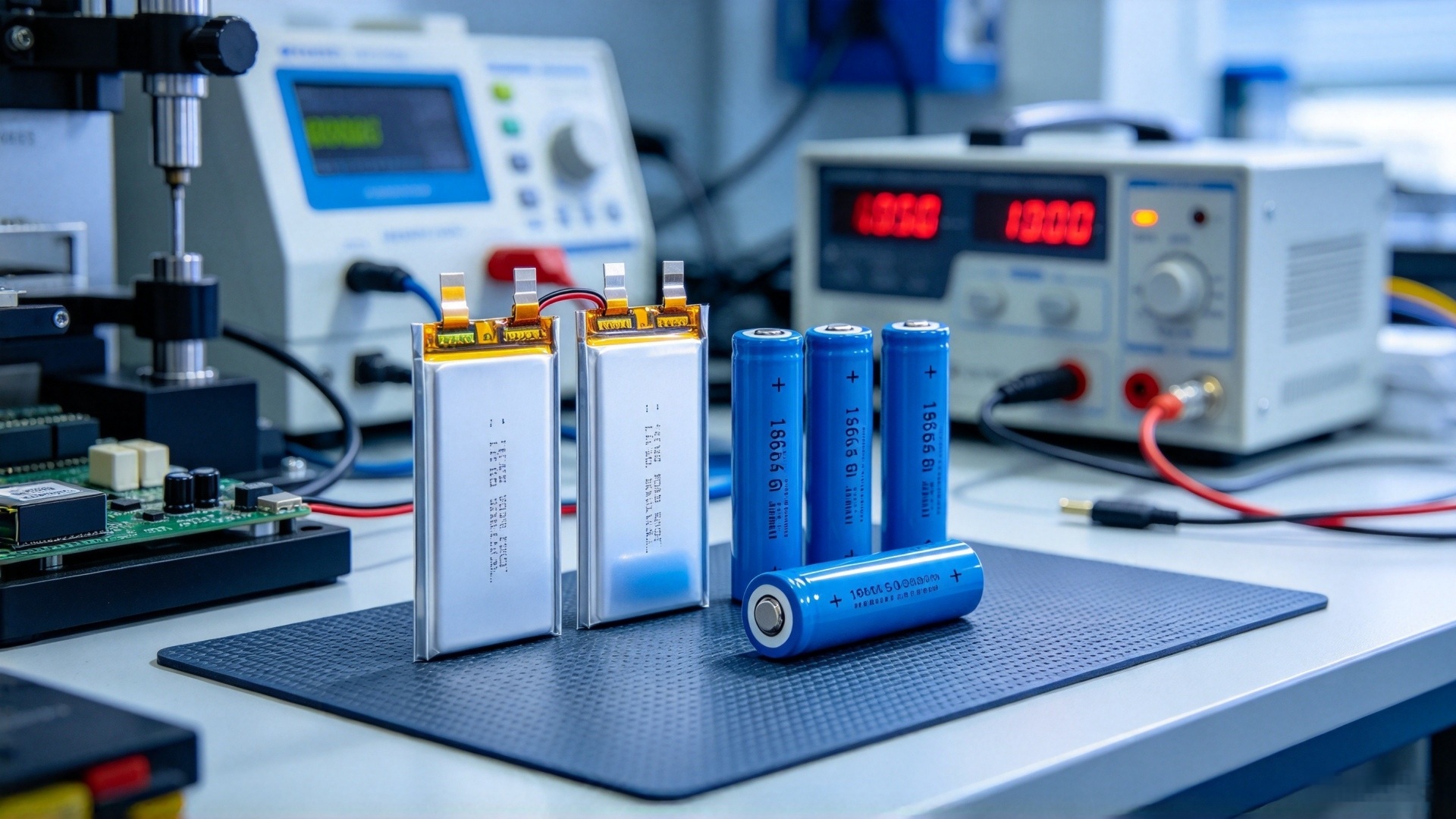
Choosing between pouch and cylindrical lithium cells is an important decision when designing custom battery packs. Each format has distinct characteristics that affect energy density, weight, thermal management, mechanical protection, and manufacturing costs.
Cylindrical cells benefit from standardized dimensions and mature mass-production processes, while pouch cells offer greater flexibility for lightweight and space-constrained designs. The right choice depends on your application's power requirements, available space, operating environment, and target cost.
This guide compares pouch and cylindrical lithium cells to help OEMs, product designers, and battery procurement teams make informed decisions.
Cylindrical lithium cells are enclosed in rigid metal cans and typically feature a wound electrode structure. Common formats include 18650 and 21700 cells, which are widely used in power tools, e-bikes, portable power banks, and other electronic devices.
Their rigid housings provide structural support and help protect the internal components during normal handling and operation. Standardized dimensions and established manufacturing processes also make many cylindrical cells readily available for large-volume production.
However, assembling multiple cylindrical cells into a battery pack requires careful electrical interconnection, cell matching, and thermal management. The number of cells and connections depends on the required voltage, capacity, and power output.
Pouch cells use flexible, aluminum-laminated packaging rather than a rigid metal can. Their internal electrode structures and electrolyte formulations vary by design, but the flexible packaging allows manufacturers to develop slim, lightweight, and customized battery configurations.
Pouch cells are commonly used in drones, RC aircraft, portable electronics, and other products where weight and enclosure dimensions are important considerations.
Their main advantage is design flexibility. However, the flexible packaging offers less inherent mechanical protection than a rigid metal housing, so pouch cells require appropriate structural support and protection against puncture, crushing, and excessive compression.
One of the key differences between pouch and cylindrical cells is how efficiently they fit into a battery pack.
Cylindrical cells have a round cross-section, which leaves gaps between adjacent cells when arranged in a typical battery module. These gaps can reduce the amount of cell volume available within a fixed enclosure, although the actual impact depends on cell spacing, cooling requirements, and module design.
Pouch cells have a flatter profile and can often be stacked more closely together. This can improve volumetric utilization, particularly in thin or irregularly shaped enclosures.
Pouch cells can also reduce packaging weight because they do not require individual rigid metal cans. However, the finished pack may still need support frames, compression structures, protective enclosures, and thermal management components. These additional components affect the overall weight advantage.
For procurement teams, it is important to distinguish between cell-level energy density and finished-pack energy density. A cell with high gravimetric or volumetric energy density does not automatically produce the lightest or most compact battery pack.
When comparing suppliers, evaluate the complete pack's dimensions, weight, usable energy, cooling requirements, and mechanical protection.
C-rate describes a battery's charge or discharge current relative to its rated capacity. For example, a discharge rate of 1C corresponds to a current equal to the rated capacity expressed in amp-hours, although actual operating limits must follow the manufacturer's specifications.
Both pouch and cylindrical cells are available in high-power designs. Their discharge performance depends on electrode design, internal resistance, current collection, chemistry, cell construction, and thermal conditions—not simply on their physical format.
Some pouch cells are designed for high discharge rates, making them suitable for applications that require substantial power relative to battery weight, such as drone takeoff and rapid acceleration in RC aircraft.
Their flat electrode structures and packaging can support compact, lightweight designs. However, high discharge capability is not guaranteed for every pouch cell. Buyers should verify the manufacturer's continuous and peak discharge ratings, allowable temperature range, and test conditions.
Cylindrical cells are available in both energy-oriented and power-oriented designs. High-power models can deliver substantial current when operated within their specified limits.
During high-current discharge, heat is generated by internal resistance and other electrochemical processes. If heat cannot dissipate efficiently, cell temperature may rise and limit sustained output. This applies to both cylindrical and pouch cells.
A cell's advertised peak discharge rate should not be treated as its continuous discharge rating. Procurement teams should confirm whether the stated current is permitted continuously or only for a limited duration, and under what temperature and cooling conditions.
Pouch cells can accommodate some dimensional changes through their flexible packaging, but this does not eliminate the risk of swelling. Gas generation, aging, and abnormal operating conditions can cause pouch cells to expand.
Cylindrical cells have rigid metal housings that help maintain their shape, but internal gas generation or excessive pressure can still create serious safety risks.
For both formats, appropriate thermal management, voltage and current protection, and compliance with the cell manufacturer's operating limits are essential.
Cylindrical cells benefit from mature manufacturing processes, standardized formats, and broad availability. These advantages can make them cost-effective for high-volume projects.
However, battery packs using many cylindrical cells may require a greater number of electrical interconnections, welds, and cell-monitoring points. Each connection must be manufactured and inspected properly to maintain pack reliability.
Pouch cells can reduce the number of individual cells required in some designs, depending on the pack's voltage and capacity requirements. Their flexible dimensions may also simplify packaging for products with limited internal space.
Nevertheless, pouch cells require careful handling during assembly and appropriate mechanical support in the finished pack. Their production cost depends on cell specifications, customization, order volume, and manufacturing requirements.
Regardless of cell format, buyers should evaluate:
Cell manufacturer, model, and traceability
Capacity and internal resistance consistency
Continuous and peak discharge ratings
BMS configuration and protection functions
Electrical connection quality
Thermal management and mechanical design
Sample validation and production quality control
For OEM projects, cell specifications alone are not enough. The finished battery pack must be validated against the actual application's electrical, mechanical, thermal, and environmental requirements.
The most suitable cell format depends on the priorities of the finished product.
Cylindrical cells are often a strong choice when a project requires standardized cell dimensions, broad supplier availability, structural protection, and cost-effective production.
Typical applications include:
Power tools
E-bikes and electric mobility systems
Portable power banks
Selected industrial battery packs
Energy storage systems designed around cylindrical cells
For applications involving vibration or impact, the entire pack still needs appropriate mounting, insulation, and mechanical protection. A rigid cell can is helpful, but it does not replace proper pack-level engineering.
Pouch cells are worth considering when low weight, compact dimensions, and flexible packaging are major priorities.
Typical applications include:
Drones and unmanned aerial vehicles (UAVs)
RC aircraft and other high-power remote-controlled equipment
Slim portable electronics
Selected medical devices
Custom-shaped battery packs
For drone manufacturers, pouch cells can be attractive when the design requires a high power-to-weight ratio. However, the selected cell must meet the required continuous and peak current, flight duration, operating temperature, and mechanical protection requirements.
A high-performance drone battery is not defined by cell format alone. Cell quality, pack configuration, wiring, connectors, BMS requirements, and thermal behavior all influence the final result.
Neither pouch nor cylindrical cells are ideal for every application.
Flexible packaging requires suitable mechanical support.
The enclosure must account for dimensional changes and potential swelling.
Puncture, crushing, and excessive compression must be prevented.
Thermal management and inspection requirements depend on the application.
Round cells can leave unused spaces within the pack.
Packs may require more individual cells and electrical interconnections.
Cell spacing and cooling arrangements can affect overall pack size and weight.
Rigid housings do not eliminate internal failure or thermal runaway risks.
The correct format is the one that balances space utilization, power capability, safety, manufacturability, and total cost for the intended application.
Before selecting a pouch or cylindrical lithium battery, define your product's requirements and evaluate the complete battery pack.
1. Define Your Space and Weight Limits
Determine the available enclosure dimensions and maximum allowable battery weight. Pouch cells may offer more flexibility for thin or irregular spaces, while cylindrical cells may be easier to integrate into designs built around standardized cell sizes.
2. Calculate Energy and Power Requirements
Specify the required voltage, capacity, continuous discharge current, peak current, and operating duration. Confirm that the selected cell can support the actual duty cycle rather than relying solely on its nominal capacity or advertised peak discharge rate.
3. Evaluate Thermal and Mechanical Conditions
Consider ambient temperature, vibration, shock, available cooling, and enclosure constraints. Ensure that the pack provides appropriate mechanical protection and maintains the cells within their specified operating limits.
4. Compare Finished-Pack Performance
Compare complete battery packs by usable energy, dimensions, weight, output capability, charging requirements, and safety features. A cell-level advantage may become less significant after adding the enclosure, wiring, BMS, and thermal management components.
5. Validate Samples Before Mass Production
Request technical specifications and sample test data from suppliers. Where appropriate, conduct testing under representative operating conditions to verify output, temperature rise, cycle performance, and mechanical integrity.
This approach helps reduce design changes, unexpected performance limitations, and quality issues after production begins.
There is no universally superior choice between pouch and cylindrical lithium cells. Cylindrical cells offer standardized formats, rigid housings, and established manufacturing processes. Pouch cells offer flexible packaging, design freedom, and the potential for excellent space and weight efficiency.
The best option depends on your project's power requirements, enclosure constraints, thermal conditions, safety needs, production volume, and budget.
For OEMs and battery procurement teams, the most reliable approach is to compare complete battery pack specifications and validate performance under real operating conditions.
The right cell format is the one that delivers the required performance, safety, and reliability within your product's design and cost constraints.
Q: Are pouch cells always better than cylindrical cells?
A: No. Pouch cells can offer advantages in weight and packaging flexibility, while cylindrical cells provide rigid housings and standardized dimensions. The better choice depends on the application, cell specifications, and complete pack design.
Q: Why can some pouch cells deliver high discharge currents?
A: Some pouch cells use electrode and current-collection designs optimized for high-power operation. Their actual discharge capability depends on internal resistance, chemistry, cell construction, and thermal conditions. Not all pouch cells are high-discharge cells.
Q: Can cylindrical cells sustain their advertised maximum C-rate continuously?
A: Not necessarily. Some ratings apply only to short-duration peak discharge. Buyers should verify the continuous discharge rating, permitted peak duration, operating temperature, and cooling conditions specified by the manufacturer.
Q: Which cell format offers better packing efficiency?
A: Pouch cells can often be stacked more closely together, while cylindrical cells leave gaps between adjacent cells. However, finished-pack efficiency also depends on cooling requirements, structural supports, wiring, and enclosure design.
Q: Which format is better for drone battery packs?
A: Pouch cells can be a strong option for drones that prioritize low weight and high power output. However, the best choice depends on flight duration, current demand, thermal conditions, mechanical protection, and the performance of the specific cells being considered.


 Hotline
 Email
 Address
RM 2201, Longshenghengbo Center, Jianshe East Road and Bulong Road Intersection, Longhua District, Shenzhen, Guangdong, China
B13 Bldg, Lihe Zijing Science and Technology Innovation Center Headquarters, No. 55, Qinghu East Road, Qingxi Town, Dongguan City, Guangdong Province, P.R. China


 Previous