

Aug 10, 2026 |BAKTH
If you shop for lithium‑ion batteries, power banks or custom battery packs, you will constantly encounter the term mAh. Many buyers take mAh at face value, yet this common metric is widely misunderstood. This guide breaks down what milliampere‑hour measures, its real‑world limits, frequent misconceptions, and how to interpret mAh correctly for consumer and OEM battery projects.
Milliampere‑hour (mAh) is the standard unit for electric charge capacity. It quantifies how much continuous current a battery can deliver over one hour of discharge. A 4000 mAh cell can theoretically output 4000 mA for one hour, or 400 mA for 10 hours.
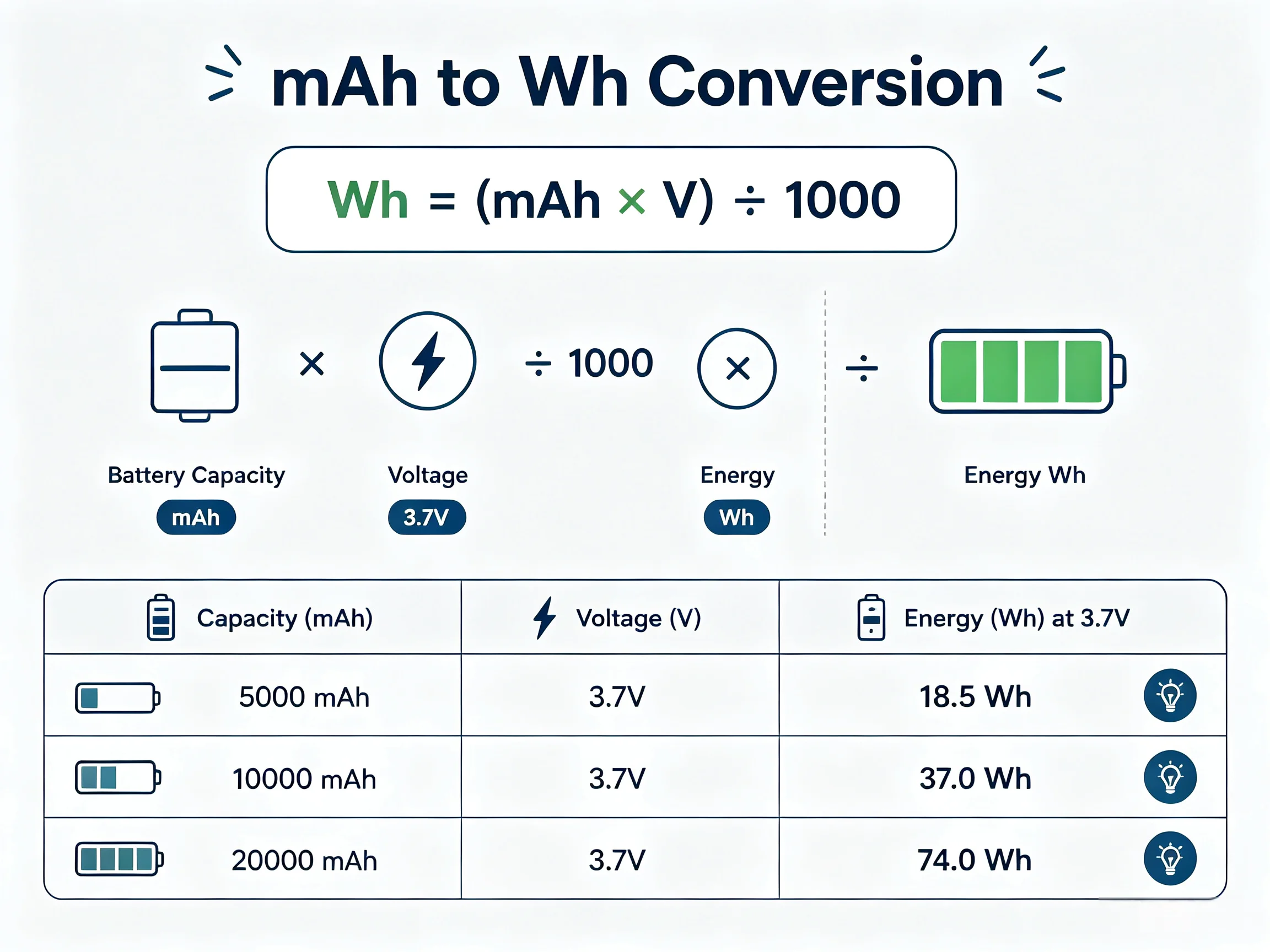
Crucially: mAh measures charge, not total stored energy. It does not include voltage in its calculation. Think of mAh as measuring how much water flows through a pipe, not how much pressure sits behind that flow. For true energy comparison, you need watt‑hours (Wh).
Wh = (mAh × Nominal Voltage) ÷ 1000
Under identical voltage, same cell chemistry and fixed device power draw, yes — a larger mAh rating will generally deliver longer run time. But this rule has critical exceptions.
Device power consumption, firmware efficiency and operating temperature heavily shape real‑world battery life. Two gadgets fitted with equal‑mAh batteries can deliver vastly different working hours, based on how hardware and software manage power drain.
This is one of the most pervasive myths: bigger mAh numbers on a datasheet do not automatically guarantee better field performance.
No, you cannot safely cross‑compare using only mAh.
Since mAh ignores voltage, two batteries with matching mAh labels may hold completely different amounts of usable energy.
Only compare mAh ratings when both cells share the same nominal voltage and identical chemistry. For mixed‑chemistry evaluation, always calculate watt‑hours.
mAh is the primary marketing metric for power banks. Remember that real‑world output is always lower than printed capacity. Conversion losses from 3.7 V cell voltage up to 5 V USB output, cable resistance and heat waste reduce usable capacity by 25‑40%. Never trust theoretical charge‑cycle math alone.
Want to swap in a higher‑mAh battery to extend run‑time? Physical fit, voltage and device power specifications come first.
Critical note: mAh describes charge capacity only. It tells you nothing about safe charging voltage. Never use a higher‑voltage charger simply because your battery has a high mAh rating. Over‑voltage charging creates swelling, permanent damage and fire hazards.
With fixed chemistry and nominal voltage, more mAh means more electrode material inside the cell. This translates to increased dimensions and heavier weight. Product designers constantly balance capacity versus portability. Compact wearables or slim handheld instruments often accept lower mAh to keep a small form‑factor.
mAh defines fixed physical charge storage. Yet modern device firmware, operating‑system power policies, screen brightness, background tasks and sleep modes determine how quickly that stored charge gets consumed. Updated firmware can extend usable hours without changing the battery’s mAh rating.
Higher‑mAh cells consume more raw mineral resources in manufacturing. Improper disposal creates larger electronic‑waste footprints. Responsible recycling programs recover lithium, copper and other metals. Advanced high‑energy‑density chemistries can achieve good run‑time with smaller physical packs, lowering overall environmental impact.
Q: Is a higher mAh battery always better?
A: Not always. It improves runtime only when voltage, form‑factor and system compatibility are satisfied. Poor device efficiency can negate capacity gains.
Q: Can I compare lithium‑ion and LiFePO4 batteries using mAh?
A: Not directly. Their nominal voltages differ. Convert both to Wh for fair comparison.
Q: Why is my power bank’s real output lower than its printed mAh?
A: Voltage conversion, circuit heat loss and cable losses reduce deliverable charge. The gap between theoretical and real output is normal.
Q: Does mAh determine charging speed?
A: Partially. Larger‑mAh packs generally take longer to fill without fast‑charge support. Charging speed is also governed by charger current and battery BMS limits.


 Hotline
 Email
Email
 Address
RM 2201, Longshenghengbo Center, Jianshe East Road and Bulong Road Intersection, Longhua District, Shenzhen, Guangdong, China
B13 Bldg, Lihe Zijing Science and Technology Innovation Center Headquarters, No. 55, Qinghu East Road, Qingxi Town, Dongguan City, Guangdong Province, P.R. China


 Previous