

Oct 19, 2026 |BAKTH
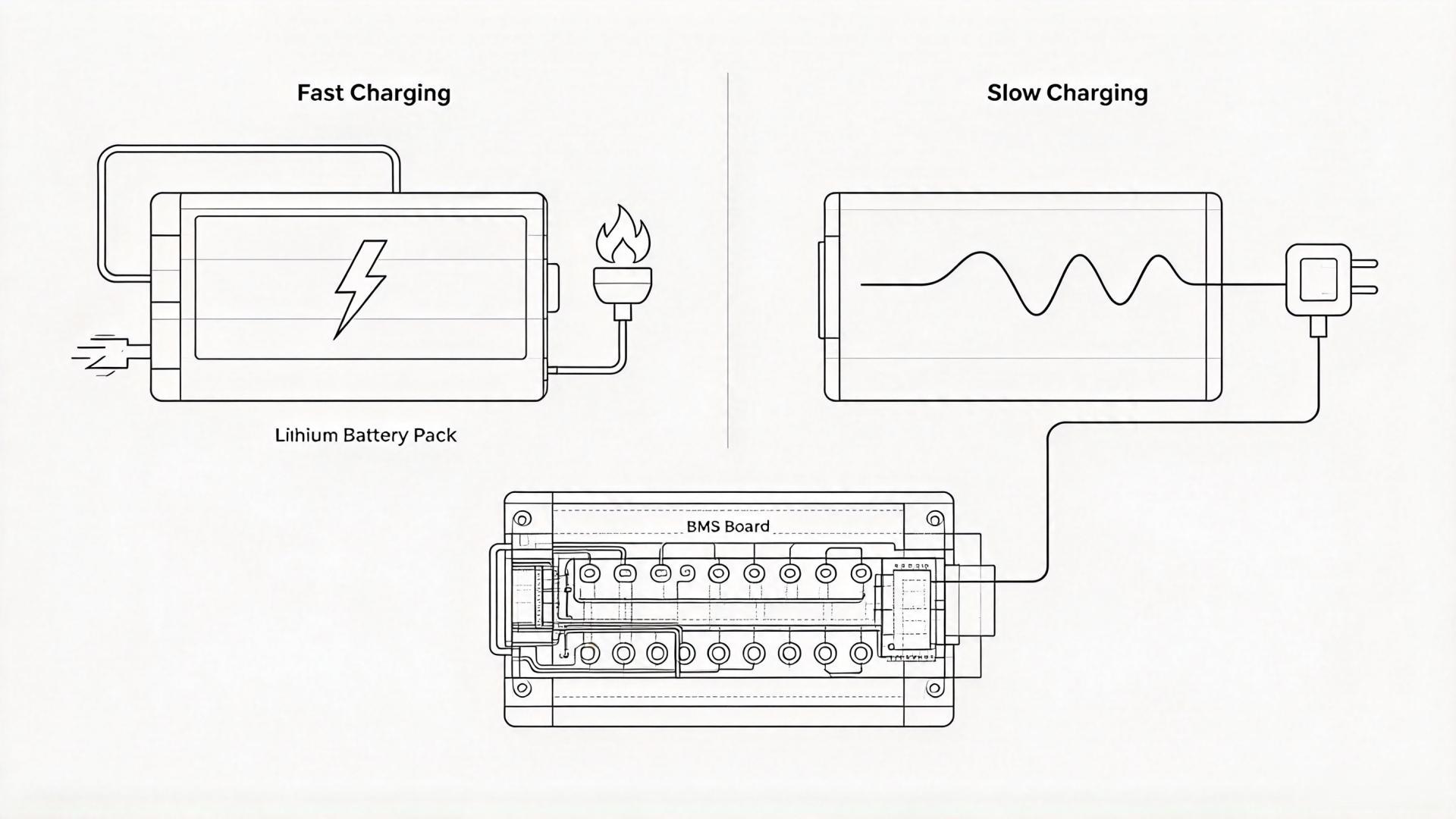
Fast charging delivers high current (typically 1C and above, often 20–120 kW for EVs) to refill a lithium battery in minutes to one hour. It relies on DC power, advanced charging algorithms and built-in thermal management. Fleet vehicles, AGVs, power tools and emergency backup systems depend on fast charging to minimize downtime.
Slow charging uses lower current (usually 0.1C–0.3C, often under 2 kW). It trickles energy into the cell over several hours. This method prioritizes cell longevity over speed, making it the default for medical devices, security systems, home electronics and long-cycle stationary storage.
High current generates heat. Internal resistance converts electrical energy into thermal energy. Without active cooling, battery temperature can climb rapidly during high-power charging. Sustained heat accelerates the growth of the solid electrolyte interphase (SEI) layer on the anode. A thicker SEI raises internal resistance, reduces usable capacity and shortens cycle life.
During fast charging, lithium ions move quickly from cathode to anode. If the anode cannot absorb ions fast enough, metallic lithium deposits on the anode surface instead of inserting into graphite layers. This phenomenon, called lithium plating, is irreversible. Plated lithium forms dendrites that pierce the separator, creating internal short circuits and permanent capacity loss.
Rapid ion movement strains electrode materials over repeated cycles. Electrode deformation, gas pocket formation and uneven cathode degradation all accelerate under high-current charging. Research shows that frequent 100% state-of-charge fast charging can cut cycle life to roughly 1,000 cycles, compared to 3,000+ cycles under controlled slow charging.
Slow charging gives lithium ions time to migrate evenly between electrodes. Lower current means lower heat, minimal lithium plating and slower SEI growth. The result is gentler chemical stress, better cell balance and higher capacity retention over thousands of cycles.
This is why medical devices, aerospace equipment and long-duration energy storage systems are almost always designed for low-current charging. The trade-off is longer downtime, but for applications where reliability matters more than speed, the lifespan gain is worth it.
| Factor | Fast Charging | Slow Charging |
|---|---|---|
| Current level | 1C and above | 0.1C–0.3C |
| Heat generation | High | Low |
| Lithium plating risk | Elevated | Minimal |
| Cycle life impact | Accelerated degradation | Extended lifespan |
| Best applications | Fleet vehicles, AGVs, emergency equipment | Medical devices, home electronics, storage |
| Downtime | Minutes to 1 hour | Several hours |
Fast charging is not inherently harmful. It becomes a problem only when used constantly without thermal controls.
Use fast charging when:
Avoid frequent fast charging for:
For battery manufacturers, fast charging does not have to come at the cost of lifespan. A well-engineered pack includes:
A hybrid charging strategy — slow charge by default, fast charge only when needed — delivers the best balance of uptime and longevity.
Q: Does fast charging always damage lithium batteries?
A: No. Occasional fast charging with proper BMS protection and thermal control is safe. Frequent, uncontrolled fast charging accelerates degradation and shortens cycle life.
Q: What charging method gives the longest battery life?
A: Slow charging at 0.2C or lower, keeping state of charge between 20% and 80%, delivers the longest cycle life for most lithium chemistries.
Q: Can I fast-charge a cold battery?
A: Never. Cold temperatures greatly increase lithium plating risk. Wait until the battery warms to the manufacturer’s recommended range before fast charging.
Q: How much does fast charging reduce battery lifespan?
A: Frequent high-rate charging without thermal management can cut cycle life by 30–60% compared to slow charging, depending on chemistry and operating temperature.
Q: Is 80% charge limit really worth it?
A: Yes. The final 20% of charging (from 80% to 100%) places the highest voltage stress on cells. Stopping at 80% significantly slows aging.
The debate between fast and slow charging is not about choosing one exclusively. Slow charging protects battery health as a daily habit. Fast charging is a useful tool when downtime costs more than battery degradation. The smartest strategy is a hybrid approach: default to slow charging, use fast charging sparingly, and rely on a well-calibrated BMS to keep cells within safe operating limits.


 Hotline
 Email
 Address
RM 2201, Longshenghengbo Center, Jianshe East Road and Bulong Road Intersection, Longhua District, Shenzhen, Guangdong, China
B13 Bldg, Lihe Zijing Science and Technology Innovation Center Headquarters, No. 55, Qinghu East Road, Qingxi Town, Dongguan City, Guangdong Province, P.R. China


 Previous